


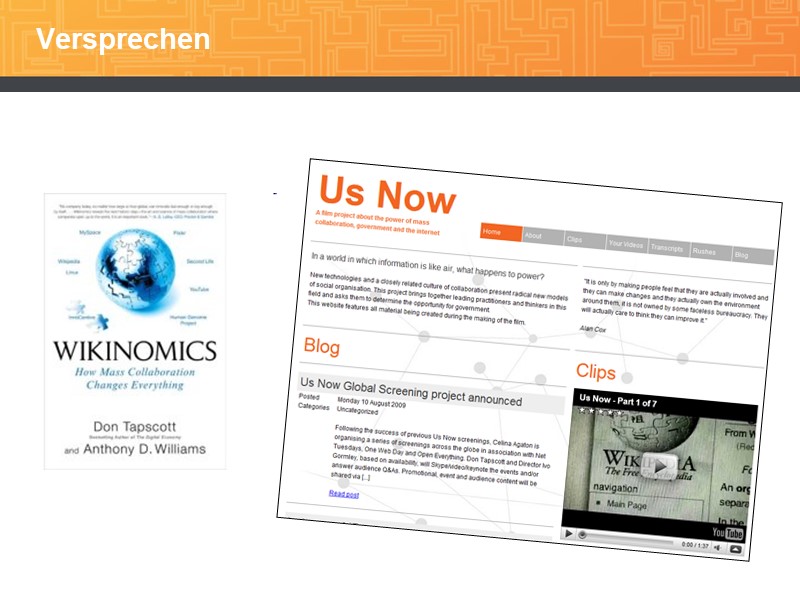
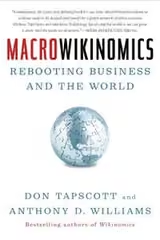
WikinomicsHow Mass Collaboration Changes Everything
|

|
 Diese Seite wurde seit 2 Jahren inhaltlich nicht mehr aktualisiert.
Unter Umständen ist sie nicht mehr aktuell.
Diese Seite wurde seit 2 Jahren inhaltlich nicht mehr aktualisiert.
Unter Umständen ist sie nicht mehr aktuell.
 Zusammenfassungen
 These four principles - openness, peering, sharing, and acting globally - increasingly define how twenty-first-century corporations compete. This is very different from the hierarchical, closed, secretive, and insular multinational that dominated the preevious century.
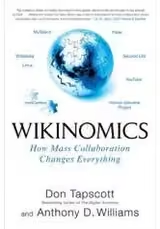 Today, encyclopedias, jetliners, operating systems, mutual funds, and many other items are being created by teams numbering in the thousands or even millions. While some leaders fear the heaving growth of these massive online communities, Wikinomics proves this fear is folly. Smart firms can harness collective capability and genius to spur innovation, growth, and success.
A brilliant primer on one of the most profound changes of our time, Wikinomics challenges our most deeply-rooted assumptions about business and will prove indispensable to anyone who wants to understand the key forces driving competitiveness in the twenty-first century.
Based on a $9 million research project led by bestselling author Don Tapscott, Wikinomics shows how the masses of people can participate in the economy like never before. They are creating TV news stories, sequencing the human genome, remixing their favorite music, designing software, finding a cure for disease, editing school texts, inventing new cosmetics, and even building motorcycles.
Immer mehr Menschen nutzen Online-Foren, sind begeisterte Blogger, arbeiten aktiv mit bei Projekten wie Open Source oder Wikipedia - beruflich und privat. Ausgeschlafene Unternehmen erkennen die Zeichen der Zeit und nutzen die neue Macht der mündigen Kunden, die sich nicht länger alles vorsetzen lassen: Sie öffnen mutig die Unternehmensgrenzen und laden buchstäblich Zigtausende von Kunden und Nutzern zum Dialog ein. So erfahren sie früher als andere, welche Produkte die Menschen wirklich begeistern, von welchen Dienstleistungen sie träumen - und wofür sie bereit sind zu bezahlen. Doch die besten Unternehmen bleiben dabei nicht stehen: Sie binden einen riesigen Talent-Pool von Forschern, Produktentwicklern, Trendscouts aus aller Welt ein. Entscheidend ist nicht, ob sie zum Unternehmen gehören oder ob sie in Amerika, Europa oder Asien leben - entscheidend ist allein, dass sie eine gute Idee mitbringen. Wie wird dieser mächtige Trend unser Leben und unsere Wirtschaft verändern? Wie können wir diese Entwicklung für uns nutzen? Dieses Buch gibt die Antwort. Bemerkungen zu diesem Buch
 Oder nehmen wir Wikipedia, für die Solutionisten die beliebteste Vorlage, nach der sie die Welt umbauen wollen; Buchtitel wie Wikinomics und Wiki Govemment zeugen davon, welche Rolle diese Website in ihrer Vorstellungswelt spielt. Das Problem, wenn man Wikipedia als Vorbild nimmt, besteht darin, dass niemand - nicht einmal ihr Gründer Jimmy Wales - wirklich weiß, wie Wikipedia funktioniert. Davon auszugeben, dass wir trotzdem lebensverändemde Lehren daraus ableiten und auf vollkommen anderen Gebieten anwenden können, ist, gelinde gesagt, arrogant. Erschwerend kommt hinzu, dass sich so viele Mythen um die Site ranken - was zu von Wikipedia inspirierten Lösungen führen könnte, die Wikipedias Geist ganz falsch widerspiegeln.
 Kapitel
- 1. Wikinomics
- 2. The perfect storm - How Technology, Demographics, and Global Economics Are Converging for the First Category 6 Business Revolution
- 3. The Peer Pioneers
- 4. Ideagoras - Marketplaces for Ideas, Innovations, and Uniquely Qualified Minds
- 5. The Prosumers - Hack This Product Please!
- 6. The New Alexandrians - Sharing for Science and the Science of Sharing
- 7. Platforms for Participation - All the World Is a Stage, and You're the Star
- 8. The Global Plant Floor - Planetary Ecosystems for Designing and Making Things
- 9. The Wiki Workplace - Unleashing the Power of Us
- 10. Collaborative Minds
 Dieses Buch erwähnt ...
 Personen KB IB clear | Yochai Benkler , John Seely Brown , Nicholas G. Carr , Art Caston , Douglas C. Engelbart , Thomas Friedman , Bill Gates , Neil Gershenfeld , Jim Giles , Jaron Lanier , Lawrence Lessig , Alex Lowy , Howard Rheingold , Peter M. Senge , James Surowiecki , Don Tapscott , David Ticoll , Linus Torvalds , Larry Wachowski , Andy Wachowski , Anthony D. Williams | |||||||||||||||||||||||||||||||||||||||||||||||||||||||||||||||||||||||||||||||||||||||||||||||||||||||||||||||||||||||||||||||||||||||
 Aussagen KB IB clear | Management=ServiceManagement = Service | |||||||||||||||||||||||||||||||||||||||||||||||||||||||||||||||||||||||||||||||||||||||||||||||||||||||||||||||||||||||||||||||||||||||
 Begriffe KB IB clear |
43Things
,  Bibliotheklibrary
, Bibliotheklibrary
,  Chatchat
, Chatchat
,  CopyrightCopyright
, corporate wikicorporate wiki
, CopyrightCopyright
, corporate wikicorporate wiki
,  creative commonscreative commons
, del.icio.us
, Dell
, creative commonscreative commons
, del.icio.us
, Dell
,  Demokratiedemocracy
, Demokratiedemocracy
,  E-Maile-mail
, flickr
, FolksonomyFolksonomy
, E-Maile-mail
, flickr
, FolksonomyFolksonomy
,  Geschäftsmodellbusiness model
, Geschäftsmodellbusiness model
,  Globalisierungglobalization
, Globalisierungglobalization
,  Hierarchiehierarchy
, Hierarchiehierarchy
,  IBM
, IBM
,  Innovationinnovation
, Innovationinnovation
,  Internetinternet
, Internetinternet
,  knowledge workerknowledge worker
, knowledge workerknowledge worker
,  Kommunismuscommunism
, Kommunismuscommunism
,  Kreativitätcreativity
, Kreativitätcreativity
,  Linux
, Metadatenmeta data
, Linux
, Metadatenmeta data
,  MIT
, MIT
,  Netzwerknetwork
, Netzwerknetwork
,  Offenheitopenness
, Ökonomieeconomy
, Ontologieontology
, Open SourceOpen Source
, Offenheitopenness
, Ökonomieeconomy
, Ontologieontology
, Open SourceOpen Source
,  PodcastPodcast
, ProsumerProsumer
, PodcastPodcast
, ProsumerProsumer
,  RSSReally Simple Syndication
, Second lifeSecond life
, Selbstorganisationself organisation
, RSSReally Simple Syndication
, Second lifeSecond life
, Selbstorganisationself organisation
,  skype
, social softwaresocial software
, Socialtext
, Taxonomietaxonomy
, Technorati
, skype
, social softwaresocial software
, Socialtext
, Taxonomietaxonomy
, Technorati
,  Terrorismusterrorism
, Terrorismusterrorism
,  Unternehmencompany
, Unternehmencompany
,  Weblogsblogging
, Wikiwiki
, Weblogsblogging
, Wikiwiki
,  Wikipedia
, Wikipedia
,  Wissenschaftscience
, Wissenschaftscience
,  WWW (World Wide Web)World Wide Web
, XML WWW (World Wide Web)World Wide Web
, XML
| |||||||||||||||||||||||||||||||||||||||||||||||||||||||||||||||||||||||||||||||||||||||||||||||||||||||||||||||||||||||||||||||||||||||
 Bücher |
| |||||||||||||||||||||||||||||||||||||||||||||||||||||||||||||||||||||||||||||||||||||||||||||||||||||||||||||||||||||||||||||||||||||||
Texte |
|
 (
(
 Dieses Buch erwähnt vermutlich nicht ...
Nicht erwähnte Begriffe | Betriebssystem, Confluence, Linux in der Schule, MediaWiki, Microsoft Windows, Podcasts in education, social bookmarking, Trackback, Unternehmenskultur, Weblogs in education, Wiki in education, Wirtschaft |
Tagcloud
 Vorträge von Beat mit Bezug
- Wie das Web 2.0 die (politische) Bildung in Bewegung bringen kann
Referat an der Tagung pb21.de: Web 2.0 in der politischen Bildung
Hattingen, 10.02.2010
2 Einträge in Beats Blog
 Zitationsgraph (Beta-Test mit vis.js)
 Zeitleiste
 45 Erwähnungen
- REMIX - Making Art and Commerce Thrive in the Hybrid Economy (Lawrence Lessig) (2008)


- Multimedia (Frank Hartmann) (2008)
- EdMedia 2008 (2008)
- Wiki as a Collaborative Learning Tool in a Language Arts Methods Class (Kathryn I. Matthew, Rebecca Callaway)
- Wiki as a Collaborative Learning Tool in a Language Arts Methods Class (Kathryn I. Matthew, Rebecca Callaway)
- LOG IN 152: Web 2.0 in der Schule (2008)
- Auf dem Weg zu einer neuen Lernkultur - Was die Schule vom Web 2.0 lernen kann (Peter Baumgartner, Klaus Himpsl)
- Auf dem Weg zu einer neuen Lernkultur - Was die Schule vom Web 2.0 lernen kann (Peter Baumgartner, Klaus Himpsl)
- Konstruktion und Kommunikation von Wissen mit Wikis - Theorie und Praxis (Johannes Moskaliuk) (2008)

- Generation Internet - Die Digital Natives: Wie sie leben - Was sie denken - Wie sie arbeiten (John Palfrey, Urs Gasser) (2008)
- 5. Kreativität
- Netzwerkanalyse und Netzwerktheorie - Ein neues Paradigma in den Sozialwissenschaften (Christian Stegbauer) (2008)
- Using Wikis for Online Collaboration - The Power of the Read-Write Web (James A. West, Margaret L. West) (2008)
- The Context of Electronic Surveillance - A Critical Case Study of the Usage of studiVZ, Facebook, and MySpace by Students in Salzburg in the Context of Electronic Surveillance (Christian Fuchs) (2009)
- Children's Participation Patterns in Online Communities - An Analysis of Israeli Learners in the Scratch Online Community (Oren Zuckerman, Ina Blau, Andrés Monroy-Hernández) (2009)
- CSCL 2009 (2009)
- Democratizing Design - New Challenges and Opportunities for Computer-Supported Collaborative Learning (Gerhard Fischer)
- Learning and Knowledge Building with Social Software (Joachim Kimmerle, Johannes Moskaliuk, Ulrike Creß)
- Democratizing Design - New Challenges and Opportunities for Computer-Supported Collaborative Learning (Gerhard Fischer)
- WikiSym 2009 (2009)
- Looking Toward the Future of Technology-Enhanced Education (Martin Ebner, Mandy Schiefner) (2009)
- The New ICT Ecosystem - Implications for Policy and Regulation (Fransman Martin) (2010)
- Inspired by Technology, Driven by Pedagogy - A Systemic Approach to Technology-Based School Innovations (CERI Center for Educational Research and Innovation) (2010)
- Curriculum 21 - Essential Education for a Changing World (2010)
- Internet-Ökonomie - Grundlagen und Fallbeispiele der vernetzten Wirtschaft (Reiner Clement, Dirk Schreiber) (2010)
- Wikis: what students do and do not do when writing collaboratively (Hagit Meishar-Tal, Paul Gorsky) (2010)
- Schools and Schooling in the Digital Age - A Critical Analysis (Neil Selwyn) (2010)
- A New Culture of Learning - Cultivating the Imagination for a World of Constant Change (Douglas Thomas, J. S. Brown) (2011)
- The Semantic Sphere - Computation, Cognition and Information Economy (Pierre Lévy) (2011)
- Visual Complexity - Mapping Patterns of Information (Manuel Lima) (2011)
- Code/Space - Software and Everyday Life (Rob Kitchin, Martin Dodge) (2011)
- The Digital Scholar - How Technology is Transforming Academic Practice (Martin Weller) (2011)
- Public Parts - How Sharing in the Digital Age Improves the Way We Work and Live (Jeff Jarvis) (2011)
- What School Leaders Need to Know About Digital Technologies and Social Media (Scott McLeod, Chris Lehmann) (2011)
- 2. Wikis (Stephanie Sandifer, Victoria Davis)
- 16. Mobile Phones and Mobile Learning (Liz Kolb, Sharon Tonner)
- 2. Wikis (Stephanie Sandifer, Victoria Davis)
- Research on e-Learning and ICT in Education (Athanassios Jimoyiannis) (2012)
- 12. The Design and Development of a Wiki Task in Undergraduate Education - Retrospects and Prospects (Ilias Karasavvidis, Sevasti Theodosiou)
- 12. The Design and Development of a Wiki Task in Undergraduate Education - Retrospects and Prospects (Ilias Karasavvidis, Sevasti Theodosiou)
- Internet - Segen oder Fluch (Kathrin Passig, Sascha Lobo) (2012)
- 1. Null oder Eins? - Ja. - Über Verständigungsschwierigkeiten
- 1. Null oder Eins? - Ja. - Über Verständigungsschwierigkeiten
- Technology enhanced collaborative learning in projects - Dimensions of knowledge building: student’s activity, collaboration and communication (Michele Notari) (2012)
- To Save Everything, Click Here - The Folly of Technological Solutionism (Evgeny Morozov) (2013)
- Digital Disconnect - How Capitalism is Turning the Internet Against Democracy (Robert McChesney) (2013)
- 1. What Is the Elephant in the Digital Room?
- The Culture of Connectivity (José van Dijck) (2013)
- The participatory web in the context of academic research - Landscapes of change and conflicts (Cristina Costa) (2013)
- Digital Exposure - Postmodern Postcapitalism (Raphael Sassower) (2013)
- Der Wiki-Weg des Lernens - Gestalten und Begleiten von Lernprozessen mit digitalen Kollaborationswerkzeugen (Michele Notari, Beat Döbeli Honegger) (2013)
- Distrusting Educational Technology - Critical Questions for Changing Times (Neil Selwyn) (2013)
- The Zero Marginal Cost Society - The Internet of Things, the Collaborative Commons, and the Eclipse of Capitalism (Jeremy Rifkin) (2014)
- Silicon Valley - Was aus dem mächtigsten Tal der Welt auf uns zukommt (Christoph Keese) (2014)
- The Future of the Professions - How Technology Will Transform the Work of Human Experts (Richard Susskind, Daniel Susskind) (2016)
- Mehr als 0 und 1 - Schule in einer digitalisierten Welt (Beat Döbeli Honegger) (2016)
- 6. Wozu Informatik? (2016)
- 6. Wozu Informatik? (2016)
- Die Zukunft der Datenökonomie - Zwischen Geschäftsmodell, Kollektivgut und Verbraucherschutz (Carsten Ochs, Michael Friedewald, Thomas Hess, Jörn Lamla) (2019)
- Kritik der Digitalität (Jan Distelmeyer) (2021)
- Big Tech muss weg! - Die Digitalkonzerne zerstören Demokratie und Wirtschaft - wir werden sie stoppen (Martin Andree) (2023)
Co-zitierte Bücher


How Big Media Uses Technology and the Law to Lock Down Culture and Control Creativity
(Lawrence Lessig) (2004) 

Warum Gruppen klüger sind als Einzelne und wie wir das kollektive Wissen für unser wirtschaftliches, soziales und politisches Handeln nutzen können
The Wisdom of Crowds
(James Surowiecki) (2004) 

Participative Web and User-Created Content
Web 2.0, Wikis and Social Networking
(OECD Organisation for Economic Co-operation and Development, Graham Vickery, Sacha Wunsch-Vincent) (2007)
a practical guide to improving productivity and collaboration in your organization
(Stewart Mader) (2008) 




Applying Social Informatics for Tertiary Teaching
(Mark J.W. Lee, Catherine McLoughlin) (2010) 




Is the Internet Changing the Way You Think?
The Net's Impact on Our Minds and Future
(John Brockman) (2011) 
How Technology Can Make Government Better, Democracy Stronger, and Citizens More Powerful
(Beth Simone Noveck) 
Elemente einer kritischen Internetkultur
Zero Comments
Blogging and Critical Internet Culture
(Geert Lovink) (2007) How blogs, MySpace, YouTube, and the rest of today's user-generated media are destroying our economy, our culture, and our values
(Andrew Keen) (2008)



 Volltext dieses Dokuments
| Wikinomics: Gesamtes Buch als Volltext (:  , 7963 kByte) , 7963 kByte) |
 Externe Links
Wikinomics: Website of the book Wikinomics ( :  2021-03-21) 2021-03-21) |
 Standorte
 Bibliographisches
| Titel | Format | Bez. | Aufl. | Jahr | ISBN | ||||||
| Wikinomics | E | - | - | 1 | 2007 | 1591841380 |  |
 |
 |
 |
|
| Wikinomics | E | Gebunden | - | 1 | 2007 | 1843546361 | |
|
|
|
|
| Wikinomics | D | Gebunden | - | 1 | 2007 | 3446412190 | |
|
|
Beat und dieses Buch
Beat war Co-Leiter des ICT-Kompetenzzentrums TOP während er dieses Buch ins Biblionetz aufgenommen hat. Die bisher letzte Bearbeitung erfolgte während seiner Zeit am Institut für Medien und Schule. Beat besitzt ein physisches und ein digitales Exemplar. (das er aber aus Urheberrechtsgründen nicht einfach weitergeben darf). Aufgrund der vielen Verknüpfungen im Biblionetz scheint er sich intensiver damit befasst zu haben. Beat hat dieses Buch auch schon in Vorträgen sowie in Blogpostings erwähnt.
 Biblionetz-History