


A New Kind of Science |
|
 Diese Seite wurde seit mehr als 7 Monaten inhaltlich nicht mehr aktualisiert. Unter Umständen ist sie nicht mehr aktuell.
 Zusammenfassungen
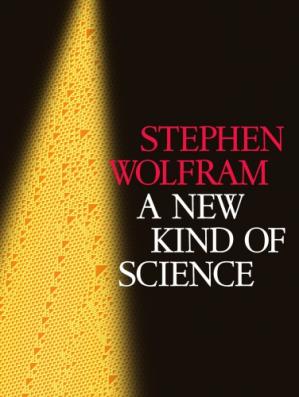
 Three centuries ago science was transformed by the dramatic new idea that rules based on mathematical equations could be used to describe the natural world. My purpose in this book is to initiate another such transformation, and to introduce a new kind of science that is based on the much more general types of rules that can be embodied in simple computer programs.
 This long-awaited work from one of the world's most respected scientists presents a series of dramatic discoveries never before made public. Starting from a collection of simple computer experiments---illustrated in the book by striking computer graphics---Wolfram shows how their unexpected results force a whole new way of looking at the operation of our universe.
 Wolfram uses his approach to tackle a remarkable array of fundamental problems in science: from the origin of the Second Law of thermodynamics, to the development of complexity in biology, the computational limitations of mathematics, the possibility of a truly fundamental theory of physics, and the interplay between free will and determinism.
Written with exceptional clarity, and illustrated by more than a thousand original pictures, this seminal book allows scientists and non-scientists alike to participate in what promises to be a major intellectual revolution.
 Bemerkungen zu diesem Buch
The core of this book can be viewed as introducing a major generalization of mathematics - with new ideas and methods, and vast new areas to be explored.Clarity and modesty. There is a common style of understated scientific writing to which I was once a devoted subscriber. But at some point I discovered that more significant results are usually incomprehensible if presented in this style. For unless one has a realistic understanding of how important something is, it is very difficult to place or absorb it. And so in writing this book I have chosen to explain straightforwardly the importance I believe my various results have. Perhaps I might avoid some criticism by a greater display of modesty, but the cost would be a drastic reduction in clarity. Kapitel
- 1. The Foundations for a New Kind of Science
- 2. The Crucial Experiment
- 3. The World of Simple Programs
- 4. Systems Based on Numbers
- 5. Two Dimensions and Beyond
- 6. Starting from Randomness
- 7. Mechanisms in Programs and Nature
- 8. Implications for Everyday Systems
- 9. Fundamental Physics
- 10. Processes of Perception and Analysis
- 11. The Notion of Computation
- 12. The Principle of Computational Equivalence
 Dieses Buch erwähnt ...
 Algorithmus
 Biologie
 Computer
 Computervirus
 Daten
Daten Denken
 Digitalisierung
 DNS
DNS Evolution
 Farbe
Farbe Fehler
 Game of Life
 Gehirn
 Geometrie
 Gott
Gott GUI (Graphical User Interface)
 Hardware
 Intelligenz
 Kommunikation
 Künstliche Intelligenz (KI / AI)
 Künstliches Leben (Artificial life)
 Leben
Leben Mathematik
 Nervensystem
 Neuronales Netz
 Philosophie
 Physik
 Psychologie
 Raum / Ort
 Retina
 Schlaf
 Software
 Sprache
 Statistik
 Symmetrie
 Wahrnehmung
 Wahrscheinlichkeitstheorie
 Wissenschaft
 Zahlen
 Zeit
Zeit Zufall


 Dieses Buch erwähnt vermutlich nicht ...
Nicht erwähnte Begriffe | Bewusstsein, blockbasierte Programmierumgebungen, Chemie, Farbkonstanz, Gehirn-Hemisphären, Informatik-Didaktik, Informatik-Unterricht (Fachinformatik), Intelligenztest / IQ, Internet, Kinder, Knapsack-Problem, Lambda-Kalkül, Mensch, Naturwissenschaft, Neurobiologie, Neuron, Relativitätstheorie, spezielle, Rückkopplung / Regelkreis, Schule, Systemdenken, Unterricht |
 Tagcloud
Zitate im Buch
In my experience the single most common mistake in doing computer experiments is to look at Systems that are vastly more complicated than is necessary.Over and over again the single most important principle that I have learned is that the best computer experiments are ones that are as simple and straightforward as possible.The key unifying idea that has allowed me to formulate the Principle of Computational Equivalence is a simple but immensely powerful one: that all processes, whether they are produced by human effort or occur spontaneously in nature, can be viewed as computations.And I suspect that in fact the cun it predominance of partial differential equations is in many respects a historical accident - and that had Computer ter.hnnlogy been developed earlier in the history of mathematics, the Situation would probably now be very different. Zitationsgraph
 Zeitleiste
 25 Erwähnungen
- Reflections on Stephen Wolfram's 'A New Kind of Science' (Ray Kurzweil)
- The Man Who Cracked The Code to Everything ...But first it cracked him. - The inside story of how Stephen Wolfram went from boy genius to recluse to science renegade. (Steven Levy) (2002)


- LOG IN 130/2004 - Künstliches Leben (2004)
- Lineare zelluläre Automaten (Alfred Hermes) (2004)
- Lineare zelluläre Automaten (Alfred Hermes) (2004)
- Didaktik der Notebook-Universität - Mobiles Lernen auf dem Digitalen Campus (Michael Kerres, Marco Kalz, Jörg Stratmann, Claudia de Witt) (2004)

- Environmental Detectives - PDAs as a Window into a Virtual Simulated World (Eric Klopfer, Kurt Squire, Henry Jenkins) (2004)
- Environmental Detectives - PDAs as a Window into a Virtual Simulated World (Eric Klopfer, Kurt Squire, Henry Jenkins) (2004)
- The Singularity Is Near - when humans transcend biology (Ray Kurzweil) (2005)
- Unterrichtskonzepte für informatische Bildung - 11. Fachtagung Informatik und Schule der Gesellschaft für Informatik (GI) in Dresden (28.-30. September 2005) (Steffen Friedrich) (2005)
- Informatik - didaktische Weiterbildung von Lehrenden (Nicole Weicker)
- Informatik - didaktische Weiterbildung von Lehrenden (Nicole Weicker)
- Tracing the Dynabook - A Study of Technocultural Transformations (John W. Maxwell) (2006)
- Complex Adaptive Systems - An Introduction to Computational Models of Social Life (John H. Miller, Scott E. Page) (2007)
- Creating a Science of Games - Communications of the ACM. Volume 50 , Issue 7 (July 2007) (2007)
- Software Studies - A Lexicon (Matthew Fuller) (2008)
- The Semantic Sphere - Computation, Cognition and Information Economy (Pierre Lévy) (2011)
- The Philosophy of Information (Luciano Floridi) (2011)
- Lehren, Lernen und Fachdidaktik - Theorie, Praxis und Forschungsergebnisse am Beispiel der Informatik (Christina Klüver, Jürgen Klüver) (2012)
- The Engine of Complexity - Evolution as Computation (John E. Mayfield) (2013)
- The Science in Computer Science (Peter Denning) (2013)
- Great Principles of Computing (Peter Denning, Craig Martell) (2015)
- Cyber-Proletariat - Global Labour in the Digital Vortex (Nick Dyer-Witheford) (2015)
- Didaktik der Informatik (Eckart Modrow, Kerstin Strecker) (2016)
- Modality matters - Understanding the Effects of Programming Language Representation in High School Computer Science Classrooms (David Weintrop) (2016)
- Artificial Intuition - The Improbable Deep Learning Revolution (Carlos E. Perez) (2017)
- The Model Thinker - What you neeed to know to make data work for you (Scott E. Page) (2018)
- Computational Thinking (Peter Denning, Matti Tedre) (2019)
- 7. Computational Science
- 9. Future Computation
- 10. Epilogue: Lessons Learned
- Engines of Order - A Mechanology of Algorithmic Techniques (Bernhard Rieder) (2020)
 Co-zitierte Bücher


 Volltext dieses Dokuments
| A New Kind of Science: Gesamtes Buch als Volltext (:  , 56101 kByte) , 56101 kByte) |
 Externe Links
http://www.wolframscience.com/: Official Web Site of the Book ( :  2021-03-21) 2021-03-21) |
 Standorte
Beat ( 01.12.2002)
 Bibliographisches
| Titel | Format | Bez. | Aufl. | Jahr | ISBN | ||||||
| A New Kind of Science | E | - | - | 1 | 2002 | 1579550088 |  |
 |
 |
 |
 Beat und dieses Buch
Beat hat dieses Buch während seiner Assistenzzeit an der ETH Zürich ins Biblionetz aufgenommen. Die bisher letzte Bearbeitung erfolgte während seiner Zeit am Institut für Medien und Schule. Beat besitzt ein physisches und ein digitales Exemplar. (das er aber aus Urheberrechtsgründen nicht einfach weitergeben darf). Aufgrund der vielen Verknüpfungen im Biblionetz scheint er sich intensiver damit befasst zu haben.
 Biblionetz-History