


Turing-Test turing test
 Synonyme
Turing-Test, turing test
 Definitionen
 A criterion proposed by Alan Turing that maintains that a system is intelligent if it can deceive a
human interrogator into believing that it is human.
A criterion proposed by Alan Turing that maintains that a system is intelligent if it can deceive a
human interrogator into believing that it is human. Ein Turingtest ist eine hypothetische Situation, in der ein Beobachter zwei Gesprächspartnern - der eine ein Mensch, der andere ein Computer - Fragen stellt, aber nicht wie, wer wer ist. Wenn der Beobachter trotz unablässigen Fragens nicht herausfinden kann, wer der Computer und wer der Mensch ist, hat der Computer den Turingtest bestanden.
 Der Mathematiker Alan Turing hat einen Test vorgeschlagen, mit
dem ermittelt werden könnte, wann Maschinen als intelligent gelten
können: Ist ein Mensch in einem Chat mit einem automatisierten und
einem menschlichen Gegenüber nicht in der Lage, zu entscheiden,
welche Nachrichten von der künstlichen Intelligenz stammen, dann
hat diese den Turing-Test bestanden.
Der Mathematiker Alan Turing hat einen Test vorgeschlagen, mit
dem ermittelt werden könnte, wann Maschinen als intelligent gelten
können: Ist ein Mensch in einem Chat mit einem automatisierten und
einem menschlichen Gegenüber nicht in der Lage, zu entscheiden,
welche Nachrichten von der künstlichen Intelligenz stammen, dann
hat diese den Turing-Test bestanden. In a 1950 paper, Alan Turing describes his concept of the Turing Test, in which a human judge Interviews both a Computer and one or more human foils using terminals (so that the judge won't be prejudiced against the Computer for lacking a warm and fuzzy appearance). If the human judge is unable to reliably unmask the Computer (as an impostor human) then the Computer wins.
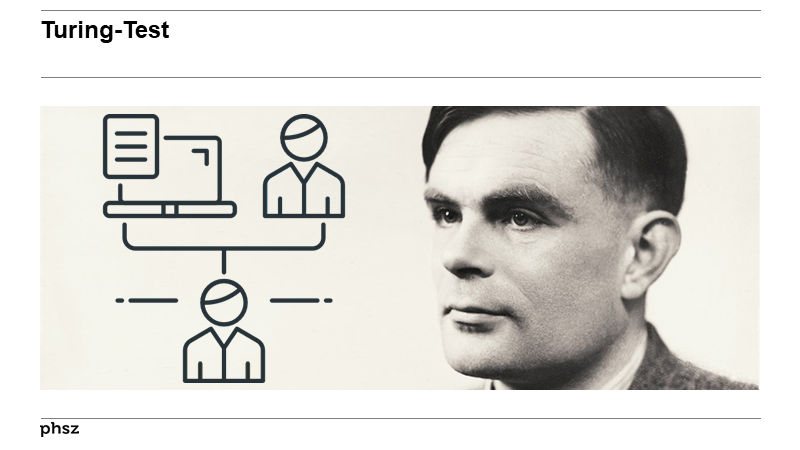
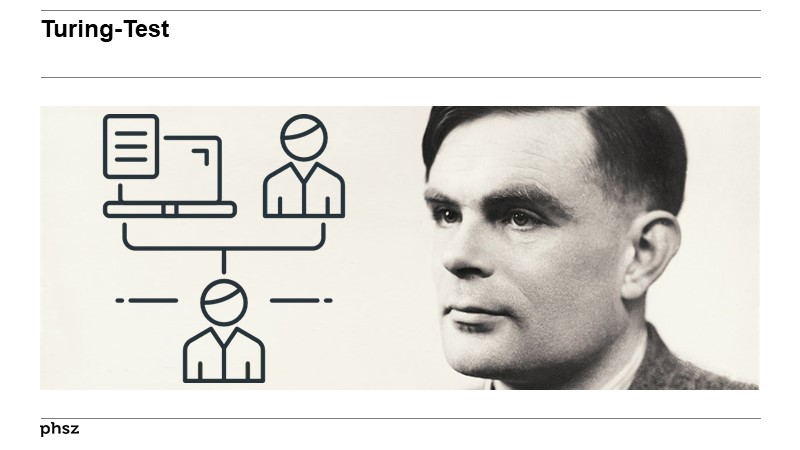
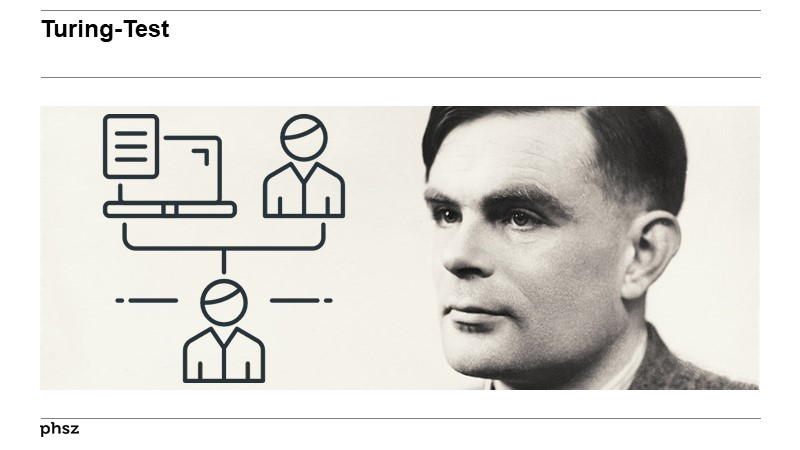
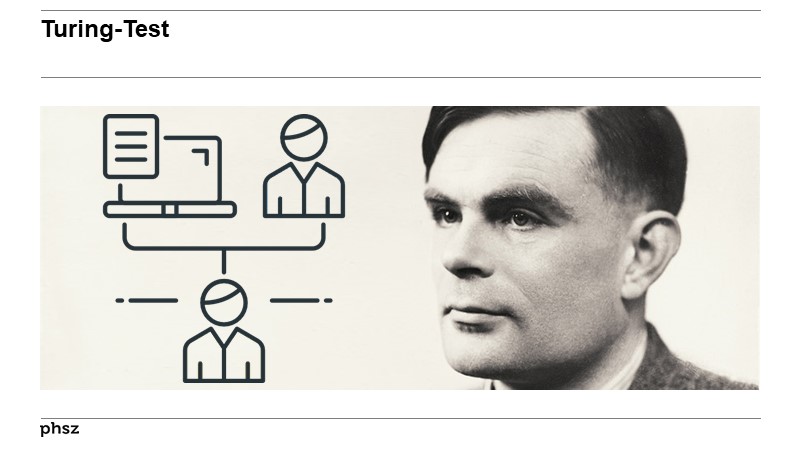
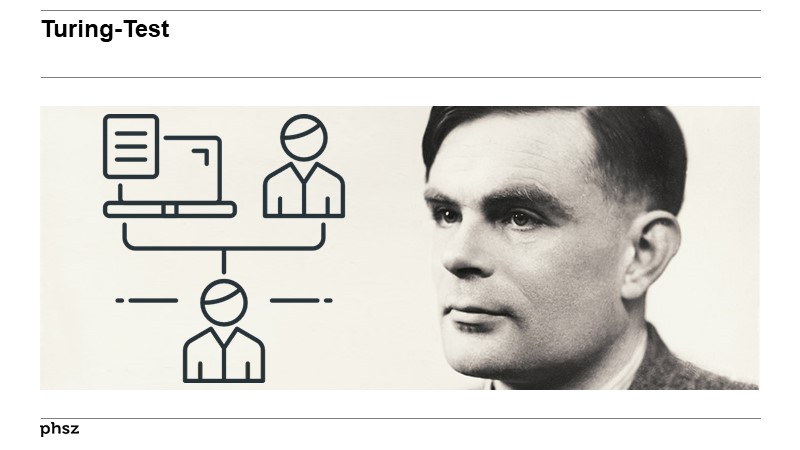
 The Turing Test’s imitation game is traditionally played by three parties: a human person (A), a computer (B), and a human interrogator (C). A and B are in a room apart. By communicating through a teletype connection, it is the interrogator’s goal to determine, which of his two partners in the room apart is human and which is the computer. Hence the question is: Can (B) be made to play satisfactorily the part of (A), such that (C) mistakes the one for the other?
 Turing’s test consisted of placing a human before a computer terminal to interact with an unknown entity through typewritten questions and answers. If, after a reasonable period, the questioner was unable to determine whether he or she was communicating with a human or a machine, then the machine could be said to be “intelligent.” Although it has several variants and has been widely criticized, from a sociological point of view the test poses the right question. In other words, it is relevant with respect to the human, not the machine.
 Beim Turing-Test (benannt nach dem Informatiker Alan M. Turing, der den
Test im Jahre 1950 vorgestellt hat) hat der Benutzer zwei Bildschirme mit
Tastaturen bzw. adäquate Ein- und Ausgabegeräte vor sich . Für die Testperson
unsichtbar, ist die eine Anordnung mit einem Menschen, die andere
mit einem Computer verbunden. Der Benutzer gibt nun Aussagen, Fragen,
Befehle etc. ein. Anhand der Antworten und Ausgaben muss er
entscheiden, hinter welcher Benutzerschnittstelle der Computer steckt.
Kann er selbst nach längerer Zeit kein Urteil fällen, gilt der Computer als
intelligent.
Beim Turing-Test (benannt nach dem Informatiker Alan M. Turing, der den
Test im Jahre 1950 vorgestellt hat) hat der Benutzer zwei Bildschirme mit
Tastaturen bzw. adäquate Ein- und Ausgabegeräte vor sich . Für die Testperson
unsichtbar, ist die eine Anordnung mit einem Menschen, die andere
mit einem Computer verbunden. Der Benutzer gibt nun Aussagen, Fragen,
Befehle etc. ein. Anhand der Antworten und Ausgaben muss er
entscheiden, hinter welcher Benutzerschnittstelle der Computer steckt.
Kann er selbst nach längerer Zeit kein Urteil fällen, gilt der Computer als
intelligent. Man stelle sich vor: Da ist ein kleines Theater mit einem roten Samtvorhang. Und hinter diesem Vorhang ist etwas, befindet sich eine nicht näher bekannte Entität. Vor dem Vorhang sitzen mehrere Gelehrte mit Zwickern, Brillen und langen Bärten. Diese Gelehrten dürfen jetzt diesem Etwas, dieser Entität Fragen stellen. Nach einiger Zeit werden sie sagen, dass sich hinter dem Vorhang eine Maschine oder ein Mensch befindet oder dass diese Frage unentscheidbar ist. Wenn sie aufgrund der gegebenen Antworten glauben, dass sich hinter dem Vorhang ein Mensch befindet, es sich aber um eine Maschine handelt, dann muss der Maschine Intelligenz zugesprochen werden.
 Wir erinnern uns folgendermaßen an den Turing-Test: Ein Computer beantwortet Fragen, die ihm von einem Menschen gestellt werden. Hält der Mensch den Computer fälschlicherweise für einen anderen Menschen, dann folgern wir daraus, dass Maschinen denken können. Dies war aber nicht, was Turing (1912–1954) im Sinn hatte. Sein Nachahmungsspiel, wie er es nannte, begann mit der Frage, wie gut wir einander verstehen.
Welchen Unterschied, wollte er wissen, können wir Menschen besser erkennen – den zwischen einem Mann und einer Frau oder den zwischen einem Computer und einer Frau? In dem Moment, da wir Frauen von Computern nicht besser unterscheiden können als von Männern, können Maschinen denken.
 You enter a room and see two terminals. One is connected to a computer and the other to a person who can speak through it from another room. You may type questions, assertions, insults, anything you wish, at either terminal, and you may do so für as lang as you like. Your goal is to decide which of the terminals is connected to a computer and which to a person. In domg so you may assume that the person is trying his ar her best to help you make the right decision - for example, not "acting mechanicaIIy" in order to confuse you. The machine, of course, is not under this constraint. If you give it a sum to add, it may weIl decide to take ist time with it, as a person would, or to make a mistake, as a person might. If it did so, the machine would not be cheating. The rules of Turing's game dictate that ist job is to simulate a person however it can. Turing suggests that if under these circumstances you cannot decide which is the computer and which is the person, you will have to conclude that the machine is intelligent:
 Bemerkungen
 Intelligente Maschinen werden bald auch den strengsten »Turing-Test« glänzend bestehen.
CAPTCHAs are similar to the Turing Test in that they distinguish humans from computers, but they differ in that the judge is now a computer.
Von Luis von Ahn, Manuel Blum, John Langford im Text Telling Humans and Computers Apart (Automatically) (2004)  Der Turing-Test ist ein operationales Messinstrument, er misst nicht die Leistung der Maschine, sondern einen Eindruck, den diese Leistung auf durchschnittliche Menschen macht.
Dazu kommt ein weiteres Problem mit dem Turing-Test: Er misst, wenn überhaupt, Intelligenz, aber jedenfalls nicht Bewusstsein. Vielleicht misst er auch nur die Fähigkeit, Intelligenz sprachlich auszudrücken. Denn ein Baby beispielsweise würde den Turing-Test nicht bestehen – dennoch würde ihm niemand Bewusstsein oder Intelligenz absprechen.
Von Eva Wolfangel im Text Lemoine und die Maschine – eine Beziehungsgeschichte (2022) The test is often described as a kind of Computer IQ test, a means of determining if computers have achieved a human level of intelligence. In my view, however, Turing really intended his Turing Test as a test of thinking, a term he uses to imply more than just clever manipulation of logic and languaee. To Turins, thinking imnlies conscious intentionality.
 The Turing test was proposed to operationalize the notion of Intelligence by means of an empirical test. It is based on the idea whether the (verbal) behavior of a Computer can be distinguished from that of a human. If it cannot be distinguished, the Computer can be said to have intelligence. Because the Turing test is based on natural language, it is restricted to human intelligence. It is still an open question whether it is a good test for human intelligence.
Verwandte Objeke
 Fragen KB IB clear | Können Computer denken?Can computers think? |
Verwandte Begriffe (co-word occurance) | Chinesisches Zimmerchinese room(0.07),  ElizaEliza(0.05), ElizaEliza(0.05),  Künstliche Intelligenz (KI / AI)artificial intelligence(0.04), Künstliche Intelligenz (KI / AI)artificial intelligence(0.04),  Chatbotchat bot(0.03), Turing-Maschineturing machine(0.03) Chatbotchat bot(0.03), Turing-Maschineturing machine(0.03) |
 Häufig erwähnende Personen
 Jürg
JürgHäufig co-zitierte Personen
 Alan
AlanTuring
 Joseph
Weizenbaum
 John R.
Searle
 Nitasha
Tiku
RayKurzweil
OpenAI JohannesGehrke
MarvinMinsky
ShakkedNoy
WhitneyZhang
SébastienBubeck
RonenEldan
EceKamar
PeterLee
Yin TatLee
YuanzhiLi
ScottLundberg
HarshaNori
HamidPalangi
Marco TulioRibeiro
YiZhang
VarunChandrasekaran
CharlesBabbage
Statistisches Begriffsnetz 
 5 Vorträge von Beat mit Bezug
- ChatGPT - der iPhone-Moment für KI?
Klausur PHSZ, Oberägeri, 14.02.2023
- ChatGPT - der iPhone-Moment des maschinellen Lernens
NMS Bern, 07.06.2023
- KVreform GPT
Kaufmännische Berufsschule Schwyz, 05.07.2023
- BBZGPT
Berufsbildungszentrum Goldau, 17.08.2023
- ChatGPT & Co. – eine Etappe auf der Reise nach Digitalien
CAS Lernreise, 19.01.2024
Erwähnungen auf anderen Websites im Umfeld von Beat Döbeli Honegger
| Website | Webseite | Datum |
|---|---|---|
| Informatikdidaktik-Wiki der PHSZ | Philosophisches zu KI | 24.03.2021 |
 Zitationsgraph
 Zeitleiste
 119 Erwähnungen
- Computers and Thought (Edward Feigenbaum, Julian Feldman) (1963)
- Psychologie des Lernens (Guy R. Lefrancois) (1972)


- 10. Künstliche Intelligenz
- What Machines Can and Cannot Do (J. C. Farrar, Jürg Nievergelt) (1972)

- Gödel, Escher, Bach - Ein endloses geflochtenes Band (Douglas Hofstadter) (1979)
- Einsicht ins Ich - Fantasien und Reflexionen über Selbst und Seele (Douglas Hofstadter, Daniel C. Dennett) (1981)
- The Second Self - Computers and the human spirit (Sherry Turkle) (1984)
- 7. The New Philosophers of Artificial Intelligence - A Culture with Global Aspirations
- Tools for Thought - The History and Future of Mind-Expanding Technology (Howard Rheingold) (1985)
- Umdenken in der Informatik (1987)
- Künstliche Intelligenz ? (Oskar Dressler)
- Computerdenken - Die Debatte um künstliche Intelligenz, Bewusstsein und die Gesetze der Physik (Roger Penrose) (1989)
- The Age of Intelligent Machines (Ray Kurzweil) (1990)
- Technopoly - The Surrender of Culture to Technology (Neil Postman) (1992)
- 7. Die Maschinen-Ideologie: Computertechnologie
- 7. Die Maschinen-Ideologie: Computertechnologie
- Technische Intelligenz oder Wie Ingenieure über Computer sprechen (Rolf Todesco) (1992)
- 5. Die technische Intelligenz
- Was ist Informatik-Didaktik? - Gedanken über die Fachkenntnisse des Informatiklehrers (Jürg Nievergelt) (1993)
- KybernEthik (Heinz von Foerster) (1993)
- Shadows of the mind - A search for the missing science of conciousness (Roger Penrose) (1994)
- Leben im Netz - Identität in Zeiten des Internet (Sherry Turkle) (1995)
- Didaktik der Informatik - bzw. einer informations- und kommunikationstechnologischen Bildung auf der Sekundarstufe II (Franz Eberle) (1996)
- 3. Entwicklung, Auswirkungen und Bedeutung der Fachinformatik sowie Trends
- Die Schule neu erfinden - Systemisch-konstruktivistische Annäherungen an Schule und Pädagogik (Reinhard Voß) (1996)
- Wir sind Erinnerung - Gedächtnis und Persönlichkeit (Daniel L. Schacter) (1996)
- 1. Vom Erinnern - Ein Fernrohr auf die Zeit gerichtet
- Künstliches Leben - Anspruch und Wirklichkeit (W. Kinnebrock) (1996)
- Auf dem Weg zur «Cyberdemocracy»? - Auswirkungen der Computernetze auf die öffentliche politische Kommunikation (Hans Geser) (1996)
- Informatik - Anwendungen, Internet, Algorithmen, Computer, Gesellschaft (René Hugelshofer, Michael Anderes, Henk Goorhuis, Ruedi Niederer) (1997)
- Wahrheit ist die Erfindung eines Lügners - Gespräche für Skeptiker (Heinz von Foerster, Bernhard Pörksen) (1998)
- Der Mensch in der Perspektive der Kognitionswissenschaften (Andreas Engel, Peter Gold) (1998)
- Philosophische Aspekte künstlicher Intelligenz (Peter Gold)
- Der Wissensnavigator - Das Lexikon der Zukunft (Artur P. Schmidt) (1999)
- Sozialpsychologie des Internet - Die Bedeutung des Internet für Kommunikationsprozesse, Identitäten, soziale Beziehungen und Gruppen (Nicola Döring) (1999)
- Fake - Leben in künstlichen Welten. Mythos Literatur Wissenschaft (Manfred Geier) (1999)
- Understanding Intelligence (Rolf Pfeifer, Christian Scheier) (1999)
- The Age of Spiritual Machines - When Computers Exceed Human Intelligence (Ray Kurzweil) (1999)
- 3. Of Mind and Machine
- 99 philosophische Rätsel (Martin Cohen) (1999)
- LOG IN 2/1999 (1999)
- Können Computer denken? - Oder: Wonach genau fragt man eigentlich, wenn man fragt, ob Computer denken können? (Reinhard Golecki) (1999)
- Können Computer denken? - Oder: Wonach genau fragt man eigentlich, wenn man fragt, ob Computer denken können? (Reinhard Golecki) (1999)
- Das Affenpuzzle - und weitere bad news aus der Computerwelt (David Harel) (2000)
- Studium generale zur Komplexität (Hans Diebner) (2001)
- 8. Realität, Aktualität, Ästhetik und Interpretation (Hans Diebner, Peter Weibel)
- Wozu Systeme? (Dirk Baecker) (2002)
- Das Geheimnis des kürzesten Weges - Ein mathematisches Abenteuer (Peter Gritzmann, René Brandenberg) (2002)
- A New Kind of Science (Stephen Wolfram) (2002)
- The New Media Reader (Noah Wardrip-Fruin, Nick Montfort) (2003)
- Welche Computer wollen wir? - Informatik zwischen Vision und Illusion (Jürg Nievergelt) (2003)
- Mediologie - Ansätze einer Medientheorie der Kulturwissenschaften (Frank Hartmann) (2003)
- Great principles of computing (Peter Denning) (2003)
- Informatik zwischen Vision und Illusion (Jürg Nievergelt) (2003)
- Alan Turing - Life and Legacy of a Great Thinker (Christof Teuscher) (2003)
- The Computer, Artificial Intelligence, and the Turing Test. (Jack Copeland, Diane Proudfoot)
- Telling Humans and Computers Apart (Automatically) - How Lazy Cryptographers do AI (Luis von Ahn, Manuel Blum, John Langford) (2004)
- E-Learning: Das Wörterbuch (Oliver Bendel, Stefanie Hauske) (2004)
- Personal Information Organisation - Studies on User-Appropriate Classification and Retrieval Strategies and their Implications for Information Management Systems Design (Pamela Ravasio) (2004)
- Web-Kommunikation mit OpenSource - Chatbots, Virtuelle Messen, Rich-Media-Content (Claus Möbus) (2005)
- Unterrichtskonzepte für informatische Bildung - 11. Fachtagung Informatik und Schule der Gesellschaft für Informatik (GI) in Dresden (28.-30. September 2005) (Steffen Friedrich) (2005)
- ANThology - Ein einführendes Handbuch zur Akteur-Netzwerk-Theorie (Andrea Belliger, David Krieger) (2006)
- FutureHype - The Myths Of Technology Change (Bob Seidensticker) (2006)
- 1. The Birthday Present Syndrome
- LOG IN 157/158/2009 (2009)
- Chatbots - Teil 2 und Schluss - Der Turing-Test und die Folgen - Zur Geschichte der symbolischen KI im Informatikunterricht (Helmut Witten, Malte Hornung) (2009)
- Chatbots - Teil 2 und Schluss - Der Turing-Test und die Folgen - Zur Geschichte der symbolischen KI im Informatikunterricht (Helmut Witten, Malte Hornung) (2009)
- You are not a Gadget - A Manifesto (Jaron Lanier) (2010)
- 50 Schlüsselideen Philosophie (Ben Dupré) (2010)
- Schöpfung ausser Kontrolle - Wie Technik uns benutzt (Karl Olsberg) (2010)
- The Most Human Human - What Talking with Computers Teaches Us About What It Means to Be Alive (Brian Christian) (2011)
- D is for Digital - What a well-informed person should know about computers and communications (Brian W. Kernighan) (2011)
- The Philosophy of Information (Luciano Floridi) (2011)
- Alone together - Why We Expect More from Technology and Less from Each Other (Sherry Turkle) (2011)
- Race Against The Machine - How the Digital Revolution is Accelerating Innovation, Driving Productivity, and Irreversibly Transforming Employment and the Economy (Erik Brynjolfsson, Andrew McAfee) (2011)
- A Brief History of Computing (Gerard O'Regan) (2012)
- 14. Alan Turing
- 15. Artificial Intelligence
- Lehren, Lernen und Fachdidaktik - Theorie, Praxis und Forschungsergebnisse am Beispiel der Informatik (Christina Klüver, Jürgen Klüver) (2012)
- The Universal Machine - From the Dawn of Computing to Digital Consciousness (Ian Watson) (2012)
- Robots Will Steal Your Job, But That's OK - how to survive the economic collapse and be happy (Frederico Pistono) (2012)
- Mensch wird Maschine, und Maschine wird Mensch (Philipp Löpfe) (2013)
- Sie wissen alles - Wie intelligente Maschinen in unser Leben eindringen und warum wir für unsere Freiheit kämpfen müssen (Yvonne Hofstetter) (2014)
- When Computers Can Think - The Artificial Intelligence Singularity (Anthony Berglas) (2015)
- Machines of Loving Grace - The Quest for Common Ground Between Humans and Robots (John Markoff) (2015)
- Die Herrschaftsformel - Wie Künstliche Intelligenz uns berechnet, steuert und unser Leben verändert (Kai Schlieter) (2015)
- 300 Keywords Informationsethik - Grundwissen aus Computer- Netz- und Neue-Medien-Ethik sowie Maschinenethik (Oliver Bendel) (2016)
- Künstliche Intelligenz - Wann übernehmen die Maschinen? (Klaus Mainzer) (2016)
- Wonderland - How Play Made the Modern World (Steven Johnson) (2016)
- Smarte Maschinen - Wie künstliche Intelligenz unser Leben verändert (Ulrich Eberl) (2016)
- Digitales Wissen. Daten und Überwachung (Thomas Christian Bächle) (2016)
- Digitaler Deutschunterricht - Neue Medien produktiv einsetzen (Philippe Wampfler) (2017)
- 3. Projekte und Unterrichtsideen
- Common Sense, the Turing Test, and the Quest for Real AI - What artificial intelligence can tell us about the mind and intelligent behavior (Hector J. Levesque) (2017)
- Life 3.0 - Being Human in the Age of Artificial Intelligence (Max Tegmark) (2017)
- 3. The Near Future: Breakthroughs, Bugs, Laws, Weapons and Jobs
- Origin (Dan Brown) (2017)
- Artificial Unintelligence (Meredith Broussard) (2018)

- The Fourth Education Revolution (Anthony Seldon, Oladimeji Abidoye) (2018)
- Warten auf die Explosion der Intelligenz (Stefan Betschon) (2018)
- Digitalisierung – Nicht nur irgendwas mit Medien - Schule leiten | Ausgabe Nr. 17/2019 (2019)
- Was bedeutet «Big Data»? - Gedanken zu einer Schule 4.0 (Helmut Lungershausen)
- Was bedeutet «Big Data»? - Gedanken zu einer Schule 4.0 (Helmut Lungershausen)
- Muster - Theorie der digitalen Gesellschaft (Armin Nassehi) (2019)
- Herausforderungen der künstlichen Intelligenz - Bericht der interdepartementalen Arbeitsgruppe «Künstliche Intelligenz» an den Bundesrat (Interdepartementale Arbeitsgruppe künstliche Intelligenz) (2019)
- Human Compatible - Künstliche Intelligenz und wie der Mensch die Kontrolle über superintelligente Maschinen behält (Stuart Russell) (2020)
- Vortrag «Bauplan für eine Seele» - Hanse-Vorträge zur modernen Biologie von Prof. Dr. Dietrich Dörner (2020)
- Und wie elektrische Schafe träumen wir - Humanität, Sexualität, Digitalität (Timothy Snyder) (2020)
- The Myth Of Artificial Intelligence - Why Computers Can’t Think The Way We Do (Erik J. Larson) (2021)
- Ideas That Created the Future - Classic Papers of Computer Science (Harry Lewis) (2021)
- Was ist Digitalität? (Uta Hauck-Thum, Jörg Noller) (2021)
- 2. Analog oder digital? - Philosophieren nach dem Ende der Philosophie (Walter Chr. Zimmerli)
- 2. Analog oder digital? - Philosophieren nach dem Ende der Philosophie (Walter Chr. Zimmerli)
- Klick - Wie wir in einer digitalen Welt die Kontrolle behalten und die richtigen Entscheidungen treffen (Gerd Gigerenzer) (2021)
- Meine Romanze mit einer virtuellen Frau (Matthias Schüssler) (2021)
- Können Programme gute Texte schreiben? - Streifzug durch die Welt der schreibenden Maschinen (Philippe Wampfler) (2021)
- Artifice and Intelligence (Emily Tucker) (2022)
- Lemoine und die Maschine – eine Beziehungsgeschichte (Eva Wolfangel) (2022)
- In der Maschine steckt kein Ich (Markus Kneer) (2022)
- Mensch, Maschine, Identität - Ethik der Künstlichen Intelligenz (Orlando Budelacci) (2022)
- Tages Anzeiger Spezialausgabe Künstliche Intelligenz (2022)
- ChatGPT ist erst der Anfang (Doris Weßels, Margret Mundorf, Nicolaus Wilder) (2022)
- Chat GPT: Der Roboter schreibt nicht, er schwafelt - Neun Missverständnisse um die Künstliche Intelligenz (Eduard Kaeser) (2022)
- Ist das auch garantiert handgeschrieben? (Hannes Bajohr) (2023)
- Chat GPT revolutioniert die künstliche Intelligenz (Heinz Moser) (2023)
- Artifizielle und postartifizielle Texte - Über die Auswirkungen Künstlicher Intelligenz auf die Erwartungen an literarisches und nichtliterarisches Schreiben (Hannes Bajohr) (2023)
- You & AI - Alles über Künstliche Intelligenz und wie sie unser Leben prägt (Anne Scherer, Cindy Candrian) (2023)
- 1. Hallo! - Hier ist KI
- Schreiben nach KI – artifizielle und postartifizielle Texte (Hannes Bajohr) (2023)
- Der Mensch wird zur Batterie (Jean-Martin Büttner) (2023)
- The Future of AI in Education - 13 Things We Can Do to Minimize the Damage (Arran Hamilton, Dylan Wiliam, John Hattie) (2023)
- The Coming Wave - Technology, Power, and the Twenty-first Century's Greatest Dilemma (Mustafa Suleyman, Michael Bhaskar) (2023)
- 11. Die Zukunft der Nationen
- 11. Die Zukunft der Nationen
- Künstliche Intelligenz, Large Language Models, ChatGPT und die Arbeitswelt der Zukunft (Michael Seemann) (2023)
- Hello World 22 - Teaching & AI (2023)
- c't KI-Praxis (2023)
- Chatbots reinlegen - Wie man KI-Sprachgeneratoren entlarvt (Arne Grävemeyer) (2023)
- Chatbots reinlegen - Wie man KI-Sprachgeneratoren entlarvt (Arne Grävemeyer) (2023)
- Generative AI and the Future of Work - A Reappraisal (Carl Benedikt Frey, Michael Osborne) (2024)
- Die alte Angst vor dem Supercomputer (Pascal Michel) (2024)
- Alles überall auf einmal - Wie Künstliche Intelligenz unsere Welt verändert und was wir dabei gewinnen können (Miriam Meckel, Léa Steinacker) (2024)
- Writing at a Distance - Notes on Authorship and Artificial Intelligence (Hannes Bajohr) (2024)
- Zwischen Macht und Mythos - Eine kritische Einordnung aktueller KI-Narrative (Rainer Rehak) (2024)
 Anderswo finden


 Volltexte
COMPUTING MACHINERY AND INTELLIGENCE: Online Fulltext ( :  2021-03-21) 2021-03-21) |
 Externe Links
| BeatBot: Der persönliche Bot von Beat Döbeli ( : 2021-03-21) |

 Biblionetz-History