


Cynthia SolomonDies ist keine offizielle Homepage von Cynthia Solomon, E-Mails an Cynthia Solomon sind hier nicht möglich! |
 |
 Diese Seite wurde seit 2 Jahren inhaltlich nicht mehr aktualisiert.
Unter Umständen ist sie nicht mehr aktuell.
 3 Bücher von Cynthia Solomon

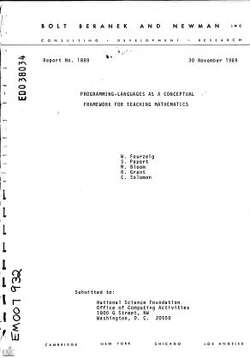
Programming-Languages as a Conceptual Framework for Teaching Mathematics
Final Report on the First Fifteen Months of the LOGO Project
(W. Feurzeig, Seymour Papert, M. Bloom, R. Grant, Cynthia Solomon) (1969)

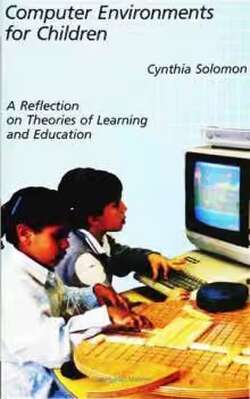
Computer Environments for Children
A Reflection on Theories of Learning and Education
(Cynthia Solomon) (1986)
 3 Texte von Cynthia Solomon
| Jahr | Volltext | Abrufe | Text | Texttyp |
|---|---|---|---|---|
| 1970 | |
0, 3, 1, 1, 6, 7, 3, 6, 2, 3, 1, 3 | NIM: A Game-Playing Program - Logo Memo No. 5 (Seymour Papert, Cynthia Solomon) | Text |
| 1971 | |
0, 0, 0, 1, 1, 1, 1, 0, 1, 1, 0, 0 | Twenty Things To Do With A Computer (Seymour Papert, Cynthia Solomon) erschienen in Studying the Novice Programmer (Seite 3 - 28) | Text |
| 1975 | |
0, 0, 0, 0, 0, 1, 0, 0, 0, 0, 0, 0 | Leading a Child to a Computer Culture - Logo Memo No. 20 (Cynthia Solomon) | Text |
 Bemerkungen von Cynthia Solomon
Von Cynthia Solomon gibt es im Biblionetz Bemerkungen zu:
 Zeitleiste
 CoautorInnen
M. Bloom, W. Feurzeig, R. Grant, Marvin Minsky, Seymour Papert, Xiao Xiao
 Zitationsnetz
 Begriffswolke von Cynthia Solomon

 Zitate von Cynthia Solomon
 The computer, when used in education, has a way of exaggerating differences: Behaviorist educators become more behaviorist, and proponents of open education come to espouse greater degrees of freedom.
 Vorträge von Beat mit Bezug
- We are all excited - but why?
Opening Keynote (Video of the keynote together with Mitch Resnick)
Scratch Conference, Amsterdam, 13.08.2015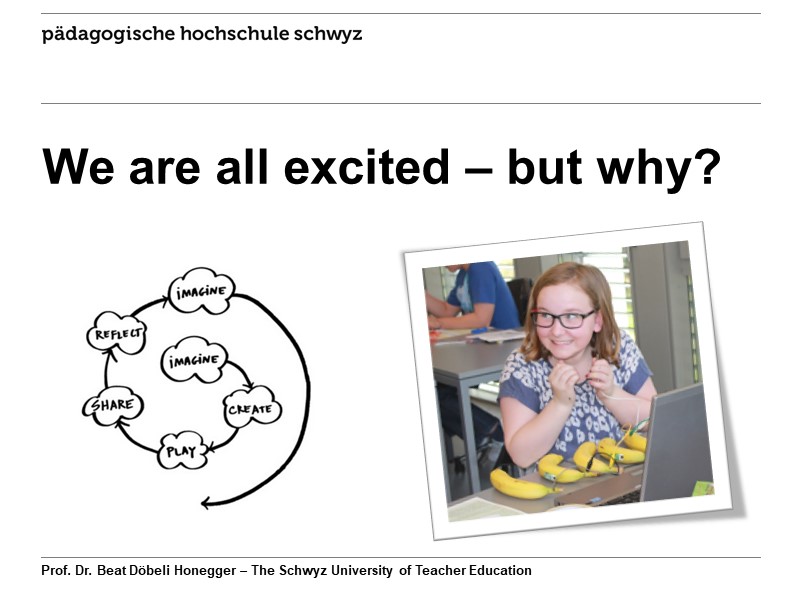

 Zitationsgraph (Beta-Test mit vis.js)
 29 Erwähnungen
- On the Cognitive Prerequisites of Learning Computer Programming - Technical Report No. 18 (Roy Pea, D. Midian Kurland) (1983)
- Logo Programming and the Development of Planning Skills - Technical Report No. 16 (Roy Pea, D. Midian Kurland) (1984)
- Computer Environments for Children - A Reflection on Theories of Learning and Education (Cynthia Solomon) (1986)
- An Exploration in the Space of Mathematics Educations (Seymour Papert) (1996)
- Beyond Adoption to Invention - Teacher-Created Collaborative Activities in Higher Education (Mark Guzdial, Jochen Rick, Colleen Kehoe) (2001)
- Never Mind the Laptops - Kids, Computers, and the Transformation of Learning (Bob Johnstone) (2003)
- Tracing the Dynabook - A Study of Technocultural Transformations (John W. Maxwell) (2006)
- Scratch im Geometrieunterricht (Klaus-Tycho Förster) (2015)
- To Block or not to Block, That is the Question - Students’ Perceptions of Blocks-based Programming (David Weintrop, Uri Wilensky) (2015)
- ICER 2015 - Proceedings of the eleventh annual International Conference on International Computing Education Research, ICER 2015, Omaha, NE, USA, August 09 - 13, (Brian Dorn, Judy Sheard, Quintin I. Cutts) (2015)
- Learner-Centered Design of Computing Education - Research on Computing for Everyone (Mark Guzdial) (2015)
- Modality matters - Understanding the Effects of Programming Language Representation in High School Computer Science Classrooms (David Weintrop) (2016)
- Coding Literacy - How Computer Programming Is Changing Writing (Annette Vee) (2017)
- Coding as a Playground - Programming and Computational Thinking in the Early Childhood Classroom (Marina Umaschi Bers) (2017)
- Lifelong Kindergarten - Cultivating Creativity through Projects, Passion, Peers, and Play (Mitchel Resnick) (2017)
- The Cambridge Handbook of Computing Education Research (Sally Fincher, Anthony V. Robins) (2019)
- Informatics in Schools. New Ideas in School Informatics (Sergei Pozdniakov, Valentina Dagienė) (2019)
- Implementing a Reverse Debugger for Logo (Renato Menta, Serena Pedrocchi, Jacqueline Staub, Dominic Weibel)
- Implementing a Reverse Debugger for Logo (Renato Menta, Serena Pedrocchi, Jacqueline Staub, Dominic Weibel)
- Scratch and the Negligent Homicide of Mathland (Gary Stager) (2020)
- The turtle and the mouse - how constructivist learning theory shaped artificial intelligence and educational technology in the 1960s (Barbra Hof) (2020)
- Schools and Screens - A Watchful History (Victoria Cain) (2021)
- Programming in K–6 - Understanding Errors and Supporting Autonomous Learning (Jacqueline Staub) (2021)
- Teaching Machines - The History of Personalized Learning (Audrey Watters) (2021)
- Computational Thinking in Education - A Pedagogical Perspective (Aman Yadav, Ulf Dalvad Berthelsen) (2021)
- 4. Democracy and Computation - A Normative Perspective on the Magic of the New Millennium (Ulf Dalvad Berthelsen, Carsten Fogh Nielsen)
- 5. Computational Thinking as Subject Matter - As an Independent Subject or Integrated across Subjects? (Morten Tannert, Rasmus Fink Lorentzen, Ulf Dalvad Berthelsen)
- Individuelle Förderung und Digitalität (Götz Bieber, Julia Gerick) (2022)
- Was unter «Individuelle Förderung und Digitalität» verstanden wird, ist oft sehr individuell… - … und wird zunehmend von der eingesetzten Software geprägt (Beat Döbeli Honegger) (2022)
- Was unter «Individuelle Förderung und Digitalität» verstanden wird, ist oft sehr individuell… - … und wird zunehmend von der eingesetzten Software geprägt (Beat Döbeli Honegger) (2022)
- MIT Technology Review 6/2023 (2023)
- Programmieren lernen funktioniert nicht für alle (Joy Lisi Rankin) (2023)
- Programmieren lernen funktioniert nicht für alle (Joy Lisi Rankin) (2023)
- ibis 2/1 (2024)
 Volltexte
| Programming-Languages as a Conceptual Framework for Teaching Mathematics: Gesamtes Buch als Volltext (:  , 9308 kByte; :  2026-10-29) |
| Twenty Things To Do With A Computer: Artikel als Volltext (: , 1088 kByte; : 2021-03-20) |
| Computer Educators: Artikel als Volltext (: , 677 kByte) |
| Computer Environments for Children: Gesamtes Buch als Volltext (: , 7202 kByte) |
| Davis: Socratic Interactions and Discovery Learnmg: Artikel als Volltext (: , 1235 kByte) |
| Dwyer: Eclecticism and Heuristic Leaming: Artikel als Volltext (: , 1258 kByte) |
| Papert: Constructivism and Piagetian Learning: Artikel als Volltext (: , 1253 kByte) |
| Preface: Artikel als Volltext (: , 5105 kByte) |
| Suppes: Drill and Practice and Rote Learning: Artikel als Volltext (: , 592 kByte) |
| Trends in Practice: Artikel als Volltext (: , 481 kByte) |
| Twenty Things To Do With A Computer: Artikel als Volltext (: , 3821 kByte; : ) |
| NIM: A Game-Playing Program: Artikel als Volltext (: , 420 kByte; : ) |
| Inventive Minds: Gesamtes Buch als Volltext (: , 41068 kByte; : 2021-03-21) |
| Leading a Child to a Computer Culture: Artikel als Volltext (Domain existiert nicht mehr) (: , 3207 kByte; :  Link unterbrochen? Letzte Überprüfung: 2026-11-09 Letzte erfolgreiche Überprüfung: 2020-10-28) |

 Biblionetz-History
