


Ubiquitous Computing Ubiquitous Computing
 Diese Seite wurde seit 4 Jahren inhaltlich nicht mehr aktualisiert.
Unter Umständen ist sie nicht mehr aktuell.
Diese Seite wurde seit 4 Jahren inhaltlich nicht mehr aktualisiert.
Unter Umständen ist sie nicht mehr aktuell.
 BiblioMap
 Definitionen

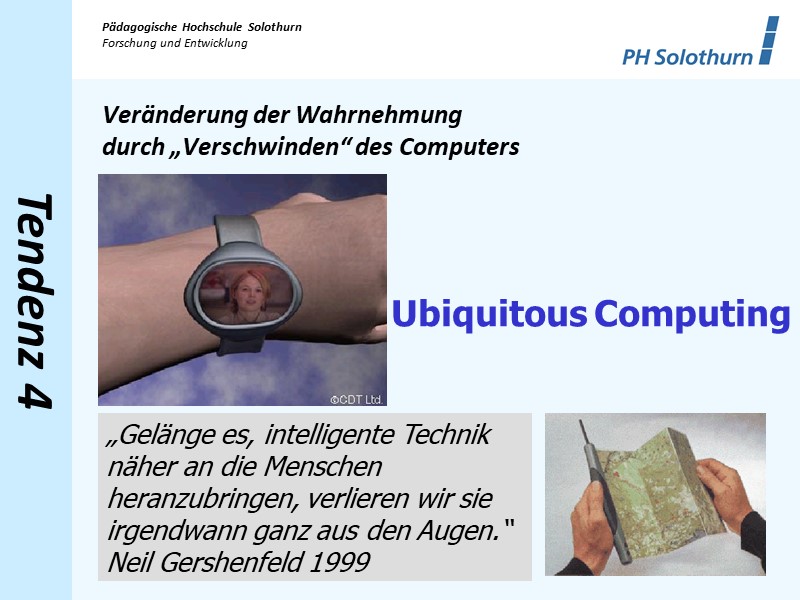
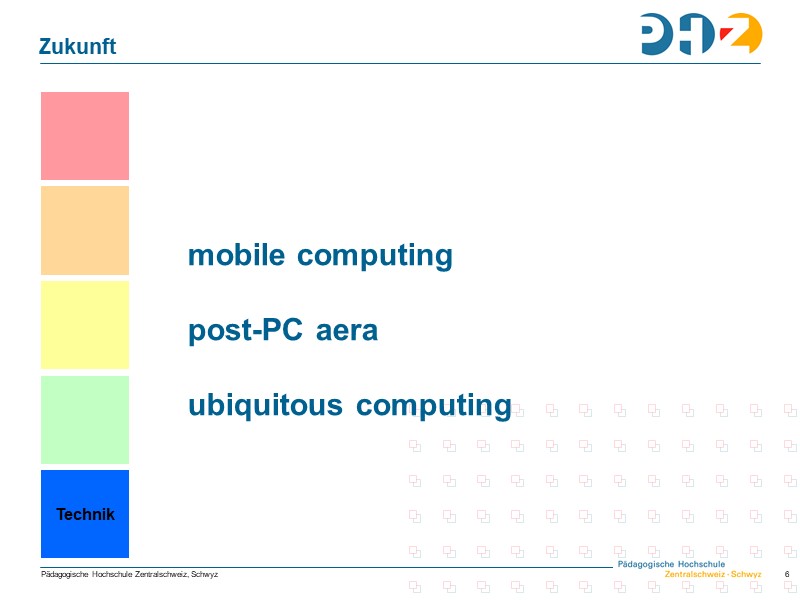
 Als "Ubiquitous Computing" (Weiser 1991, 1993) wird die Tendenz zur Verschmelzung von Computern mit bisher nicht computerisierten Gegenständen sowie zu deren Vernetzung bezeichnet.
 im Buch CSCL-Kompendium (2004) im Text Perspektiven
  Bemerkungen
Gelänge es, intelligente Technik näher an die Menschen heranzubringen, verlieren wir sie irgendwann ganz aus den Augen.
Von Neil Gershenfeld in der Zeitschrift GDI Impuls 2/99 (1999) im Text Dinge, die denken auf Seite 8 The most profound technologies are those that disappear. They weave themselves into the fabric of everyday life until they are indistinguishable from it.
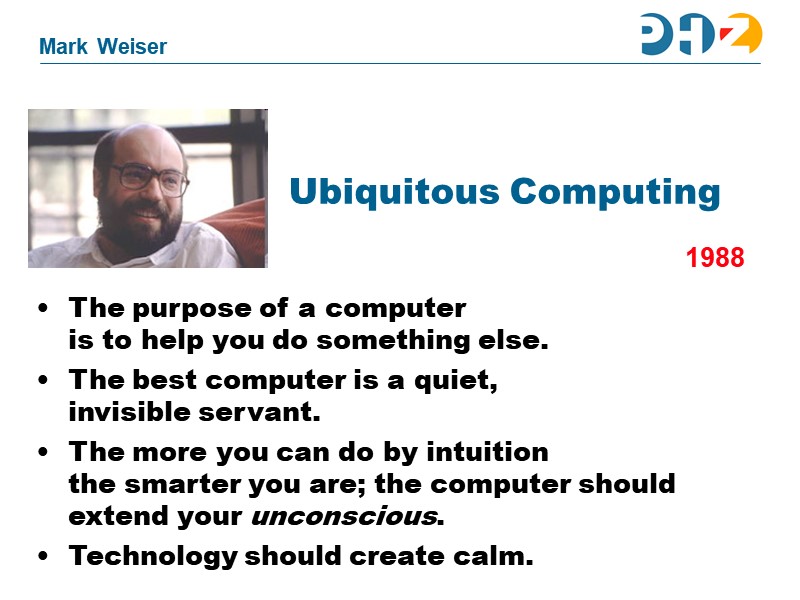
 Der Begriff "Ubiquitous Computing" wurde bereits Anfang der 1990er-Jahre von
Mark Weiser, bis zu seinem frühen Tod 1999 leitender Wissenschaftler am Forschungszentrum von XEROX in Palo Alto, geprägt und in seinem schon vom Titel
her visionären Aufsatz "The computer for the 21st century" beschrieben.Hundreds of computers in a room could seem intimidating at first, just as hundreds of volts coursing through wires
in the walls did at one time. But like the wires in the walls, these hundreds of computers will come to be invisible to
common awareness. People will simply use them unconsciously to accomplish everyday tasks.
Der Begriff "Ubiquitous Computing" wurde bereits Anfang der 1990er-Jahre von
Mark Weiser, bis zu seinem frühen Tod 1999 leitender Wissenschaftler am Forschungszentrum von XEROX in Palo Alto, geprägt und in seinem schon vom Titel
her visionären Aufsatz "The computer for the 21st century" beschrieben.Hundreds of computers in a room could seem intimidating at first, just as hundreds of volts coursing through wires
in the walls did at one time. But like the wires in the walls, these hundreds of computers will come to be invisible to
common awareness. People will simply use them unconsciously to accomplish everyday tasks. The emergence of the ubiquitous computing paradigm in the early 1990s marked the
beginning of a new era of computation in the workplace. Weiser envisioned a world in
which we no longer focus our attention on a single box while we work with information;
rather, the proliferation of small, powerful, connected computing devices would allow
computation to "vanish into the background" (Weiser, 1991)."Ubiquitous computing" in this context does not just mean computers that can be carried to the beach, jungle or
airport. Even the most powerful notebook computer, with access to a worldwide information network, still focuses
attention on a single box. By analogy to writing, carrying a super-laptop is like owning just one very important
book. Customizing this book, even writing millions of other books, does not begin to capture the real power of
literacy.How do technologies disappear into the background? The vanishing of electric motors may serve as an instructive
example: At the turn of the century, a typical workshop or factory contained a single engine that drove dozens or
hundreds of different machines through a system of shafts and pulleys. Cheap, small, efficient electric motors made it possible first to give each machine or tool its own source of motive force, then to put many motors into a single machine.My colleagues and I at PARC believe that what we call ubiquitous computing will gradually emerge as the
dominant mode of computer access over the next twenty years. Like the personal computer, ubiquitous computing
will enable nothing fundamentally new, but by making everything faster and easier to do, with less strain and
mental gymnastics, it will transform what is apparently possible. Desktop publishing, for example, is fundamentally
not different from computer typesetting, which dates back to the mid 1960's at least. But ease of use makes an
enormous difference.By pushing computers into the background, embodied virtuality will make individuals more aware of the people on
the other ends of their computer links. This development carries the potential to reverse the unhealthy centripetal
forces that conventional personal computers have introduced into life and the workplace. Even today, people holed
up in windowless offices before glowing computer screens may not see their fellows for the better part of each day.
And in virtual reality, the outside world and all its inhabitant effectively ceases to exist. Ubiquitous computers, in
contrast, reside in the human world and pose no barrier to personal interactions. If anything, the transparent
connections that they offer between different locations and times may tend to bring communities closer together.
The emergence of the ubiquitous computing paradigm in the early 1990s marked the
beginning of a new era of computation in the workplace. Weiser envisioned a world in
which we no longer focus our attention on a single box while we work with information;
rather, the proliferation of small, powerful, connected computing devices would allow
computation to "vanish into the background" (Weiser, 1991)."Ubiquitous computing" in this context does not just mean computers that can be carried to the beach, jungle or
airport. Even the most powerful notebook computer, with access to a worldwide information network, still focuses
attention on a single box. By analogy to writing, carrying a super-laptop is like owning just one very important
book. Customizing this book, even writing millions of other books, does not begin to capture the real power of
literacy.How do technologies disappear into the background? The vanishing of electric motors may serve as an instructive
example: At the turn of the century, a typical workshop or factory contained a single engine that drove dozens or
hundreds of different machines through a system of shafts and pulleys. Cheap, small, efficient electric motors made it possible first to give each machine or tool its own source of motive force, then to put many motors into a single machine.My colleagues and I at PARC believe that what we call ubiquitous computing will gradually emerge as the
dominant mode of computer access over the next twenty years. Like the personal computer, ubiquitous computing
will enable nothing fundamentally new, but by making everything faster and easier to do, with less strain and
mental gymnastics, it will transform what is apparently possible. Desktop publishing, for example, is fundamentally
not different from computer typesetting, which dates back to the mid 1960's at least. But ease of use makes an
enormous difference.By pushing computers into the background, embodied virtuality will make individuals more aware of the people on
the other ends of their computer links. This development carries the potential to reverse the unhealthy centripetal
forces that conventional personal computers have introduced into life and the workplace. Even today, people holed
up in windowless offices before glowing computer screens may not see their fellows for the better part of each day.
And in virtual reality, the outside world and all its inhabitant effectively ceases to exist. Ubiquitous computers, in
contrast, reside in the human world and pose no barrier to personal interactions. If anything, the transparent
connections that they offer between different locations and times may tend to bring communities closer together. Verwandte Objeke
Verwandte Begriffe (co-word occurance) | RFID(0.05) |
 Verwandte Aussagen | ubiquitous computing hilft bei der Überwindung der Informationsflut Moore's Law ermöglicht ubiquitous computing Ubiquitous Computing gefährdet die Privatsphäre |
 Relevante Personen
Häufig erwähnende Personen
Häufig co-zitierte Personen
MarkWeiser
 Markus
Dierkes
OliverChrist
ElgarFleisch
FriedemannMattern
 Jeremy
Roschelle
GordonMoore
MicheleRousseau
Gabriel DelReal
DavidGrant
JunRekimoto
Statistisches Begriffsnetz
 3 Vorträge von Beat mit Bezug
- Leise Revolution in der (Hoch-) Schule?
Wie Wikis, Weblogs und andere Social Software Lernen und Zusammenarbeit verändern ... können
Universität Hamburg, 21.09.2005
- ICT in der Schule
Alltäglich ungenutzt?
Arbeitsgruppe "Zukunft Bildung Schweiz" der Akademien der Wissenschaften Schweiz, 26.05.2008
- Web 3.0
Was ewartet uns da?
Zürich, 15.11.2008
5 Einträge in Beats Blog
 Zitationsgraph
Zitationsgraph (Beta-Test mit vis.js)
 Zeitleiste
 84 Erwähnungen
- Reflect - An Interactive Table for Regulating Face-to-Face Collaborative Learning (Khaled Bachour, Frédéric Kaplan, Pierre Dillenbourg)


- The Computer for the 21st Century (Mark Weiser) (1991)
- Total Digital - Die Welt zwischen 0 und 1 oder Die Zukunft der Kommunikation (Nicholas Negroponte) (1995)

- Pianos, not Stereos - Creating computational construction kits (Mitchel Resnick, Amy Bruckman, Fred Martin) (1996)
- Grundlagen hypermedialer Lernsysteme - Theorie - Didaktik - Design (Rolf Schulmeister) (1996)
- Campus-Wide Computing - Communications of the ACM, Volume 41, Number 1 (1998)
- A strategic plan for ubiquitous laptop computing (David G. Brown, Jennifer J. Burg, Jay L. Dominick)
- The Future of Ubiquitous Computing on Campus (Mark Weiser)
- A strategic plan for ubiquitous laptop computing (David G. Brown, Jennifer J. Burg, Jay L. Dominick)
- Cooperative Buildings: Integrating Information, Organization, and Architecture - First International Workshop, CoBuild’98 Darmstadt, Germany, February 25-26, 1998 (1998)
- The Aware Home - A Living Laboratory for Ubiquitous Computing Research (Cory D. Kidd, Robert Orr, Gregory D. Abowd, Christopher G. Atkeson, Irfan A. Essa, Blair MacIntyre, Elizabeth D. Mynatt, Thad Starner, Wendy Newstetter) (1999)
- GDI Impuls 2/99 - Vierteljahresschrift für Entscheidungsträger in Wirtschaft und Gesellschaft (Gottlieb Duttweiler Institut) (1999)
- Dinge, die denken - Hardware, Software, "Humanware"? (Neil Gershenfeld)
- Die Kunst vernetzt zu denken - Ein neuer Umgang mit Komplexität (Frederic Vester) (1999)
- CSCW-Kompendium - Lehr- und Handbuch zur computerunterstützten Gruppenarbeit (Gerhard Schwabe, Norbert Streitz, Rainer Unland) (2001)
- 48. Ubiquitous Computing (Michael Koch, Johann Schlichter)
- 48. Ubiquitous Computing (Michael Koch, Johann Schlichter)
- Bleistiftspitzen, Autofahren und Computern - Teil der gymnasialen Ausbildung? (Werner Hartmann, Raimond Reichert) (2001)
- Computer Support for Collaborative Learning - Foundations for a CSCL Community - Proceedings of CSCL 2002 (Gerry Stahl) (2002)
- A walk on the WILD side - How wireless handhelds may change CSCL (Jeremy Roschelle, Roy Pea) (2002)
- A walk on the WILD side - How wireless handhelds may change CSCL (Jeremy Roschelle, Roy Pea) (2002)
- Perspektive Datenschutz - Praxis und Entwicklungen in Recht und Technik (Bruno Baeriswil, Beat Ruedin) (2002)
- Datenschutz - wie weiter?
- Leonardo's Laptop - Human Needs and the New Computing Technologies (Ben Shneiderman) (2002)
- Smart Mobs - The Next Social Revolution (Howard Rheingold) (2002)
- Überleben im digitalen Zeitalter - Strategien, Technologien und Innovationen für den neuen Aufschwung (Artur P. Schmidt) (2002)
- Vorwort des Autors
- Unlocking the learning value of wireless mobile devices (Jeremy Roschelle) (2003)
- Educational scenarios for cooperative use of Personal Digital Assistants (Niels Pinkwart, Heinz Ulrich Hoppe, M. Milrad, J. Perez) (2003)
- The use of palmtop computers for learning - a review of the literature (P. Kent, Carol Savill-Smith) (2003)
- Total vernetzt - Ubiquitous Computing in einer informatisierten Welt (Friedemann Mattern) (2003)
- Vom Verschwinden des Computers - Die Vision des Ubiquitous Computing
- Vom Verschwinden des Computers - Die Vision des Ubiquitous Computing
- Headmap - mapping out spatialised computing (2003)
- Never Mind the Laptops - Kids, Computers, and the Transformation of Learning (Bob Johnstone) (2003)
- DeLFI 2004 - Tagung der Fachgruppe e-Learning der Gesellschaft für Informatik e.V. (GI) 6.-8. September 2004 in Paderborn (Gregor Engels, Silke Seehusen) (2004)
- Die Interaktive Vorlesung in der Praxis (Nicolai Scheele, Anja Wessels, Wolfgang Effelsberg) (2004)
- Die Interaktive Vorlesung in der Praxis (Nicolai Scheele, Anja Wessels, Wolfgang Effelsberg) (2004)
- The Promise of Ubiquitous Computing in Schools - A Report of a Four Year Evaluation of the Laptop Initiative at Athens Academy (Janette R. Hill, Thomas C. Reeves) (2004)
- CSCL-Kompendium - Lehr- und Handbuch zum computerunterstützen kooperativen Lernen (Jörg M. Haake, Gerhard Schwabe, Martin Wessner) (2004)
- Educause Review 40/1 - January/February 2005 Volume 40, Number 1 (2005)
- Pervasive Computing goes to School (William O. Plymale)
- Pervasive Computing goes to School (William O. Plymale)
- 20 Jahre Schulinformatik in Österreich - und IKT-Einsatz im Unterricht (Anton Reiter) (2005)
- Educause Quarterly 2/05 (2005)
- Trends in Current Issues, Y2K-2005 (Peter B. DeBlois, Leslie Maltz)
- Trends in Current Issues, Y2K-2005 (Peter B. DeBlois, Leslie Maltz)
- Web Based Training 2005 (Maike Franzen) (2005)
- Leben und Lernen in einer von Informationstechnologie durchdrungenen Welt - Visionen und Erwartungen (Friedemann Mattern)
- Leben und Lernen in einer von Informationstechnologie durchdrungenen Welt - Visionen und Erwartungen (Friedemann Mattern)
- Das Internet der Dinge - Ubiquitous Computing und RFID in der Praxis: Visionen, Technologien, Anwendungen, Handlungsanleitungen (Elgar Fleisch, Friedemann Mattern) (2005)
- Die betriebswirtschaftliche Vision des Internets der Dinge (Elgar Fleisch, Oliver Christ, Markus Dierkes)
- Die Privatsphäre im Ubiquitous Computing - Datenschutzaspekte der RFID-Technologie (Marc Langheinrich)
- Die technische Basis für das Internet der Dinge (Friedemann Mattern)
- Zahlungsverfahren mit Ubiquitous Computing (Sandra Gross, Matthias Lampe, René Müller)
- Die betriebswirtschaftliche Vision des Internets der Dinge (Elgar Fleisch, Oliver Christ, Markus Dierkes)
- Knowledge Visualization - The use of complementary visual representations for the transfer of knowledge. A model, a framework, and four new approaches (Remo A. Burkhard) (2005)
- 9. Conclusions
- Soziale Maschinen (Wade Roush) (2005)
- Ambient Findability - What We Find Changes Who We Become (Peter Morville) (2005)
- Linking Physical and Virtual Worlds with Visual Markers and Handheld Devices - Dissertation, Eidgenössische Technische Hochschule ETH Zürich, Nr. 16193 (Michael Rohs) (2005)
- The Impact of Ubiquitous Computing in the Internet Age - How Middle School Teachers Integrated Wireless Laptops in the Initial Stages of Implementation (Kathleen Burns, Jospeh Polman) (2006)
- One-to-one technology-enhanced learning - An opportunity for global research collaboration (Tak-Wai Chan, Jeremy Roschelle, S. Hsi, Kinshuk, Mike Sharples, Tom Brown, Charles Patton, J. Cherniavsky, Roy Pea, Cathleen Norris, Elliot Soloway, N. Balacheff, Marlene Scardamalia, Pierre Dillenbourg, C. Looi, M. Milrad, Heinz Ulrich Hoppe) (2006)
- Implementation and Effects Of One-to-One Computing Initiatives - A Research Synthesis (William R. Penuel) (2006)
- Big Issues in Mobile Learning - Report of a workshop by the Kaleidoscope Network of Excellence Mobile Learning Initiative (Mike Sharples) (2006)
- What is mobile learning? (Niall Winters)
- What is mobile learning? (Niall Winters)
- 1-To-1-Learning - Laptop Programs That Work (Pamela Livingston) (2006)
- Computational Thinking (Jeannette M. Wing) (2006)
- OpenSource Jahrbuch 2006 - Zwischen Softwareentwicklung und Gesellschaftsmodell (Matthias Bärwolff, Robert A Gehring, Bernd Lutterbeck) (2006)
- Die Zukunft der Wissensgesellschaft (Bernd Lutterbeck)
- Die Zukunft der Wissensgesellschaft (Bernd Lutterbeck)
- Everyware - The Dawning Age of Ubiquitous Computing (2006)
- Arbeit - Womit wir uns in Zukunft beschäftigen werden (Gottlieb Duttweiler Institut) (2006)
- Das releveante Neue (Bruno Giussani)
- Das releveante Neue (Bruno Giussani)
- Beyond the Desktop Metaphor - Designing Integrated Digital Work Environments (V. Kaptelinin, M. Czerwinski) (2006)
- 7. Supporting Activity in Desktop and Ubiquitous Computing (Stephen Voida, Elizabeth D. Mynatt, Blair MacIntyre)
- 7. Supporting Activity in Desktop and Ubiquitous Computing (Stephen Voida, Elizabeth D. Mynatt, Blair MacIntyre)
- DeLFI 2006 - 4. e-Learning Fachtagung Informatik - Proceedings (Max Mühlhäuser, Guido Rößling, Ralf Steinmetz) (2006)
- Mobile Learning is Coming of Age - What we have and what we still miss (Dirk Frohberg) (2006)
- Mobile Learning is Coming of Age - What we have and what we still miss (Dirk Frohberg) (2006)
- Web 2.0 - das 'neue' Internet macht Schule! (Volker Rüddigkeit) (2006)
- Qualität im e-Learning - elearningpapers Ausgabe Nr. 2 (2007)
- Die Informatisierung des Alltags - Leben in smarten Umgebungen (Friedemann Mattern) (2007)
- The Role of Technology in CSCL (Heinz Ulrich Hoppe, Hiroaki Ogata, A. Soller) (2007)
- Web 2.0 - Schlagwort oder Megatrend? - Fakten, Analysen, Prognosen (Gernot Gehrke) (2007)
- Das Glück der Unerreichbarkeit - Wege aus der Kommunikationsfalle (Miriam Meckel) (2007)
- In der Kommunikationsfalle - Datenflut und Denkebbe
- Mobile Learning - towards a research agenda (Norbert Pachler) (2007)
- 2. Ubiquitous computing - digital augmentation and learning (Sara Price)
- PHZ-Inforum 3/2007 - Schwerpunkt: Wikipädagogik oder Pädablogik? (2007)
- Vom Konsumenten zum Produzenten - Was bringt die "zweite" Auflage des Internets? (Beat Döbeli Honegger)
- Vom Konsumenten zum Produzenten - Was bringt die "zweite" Auflage des Internets? (Beat Döbeli Honegger)
- Emerging technologies for learning III (BECTA) (2008)
- Location-based and context-aware education - prospects and perils (Adam Greenfield)
- Location-based and context-aware education - prospects and perils (Adam Greenfield)
- Interesse wecken und Grundkenntnisse vermitteln - 3. Münsteraner Workshop zur Schulinformatik - 7. Mai 2008 (Marco Thomas, Michael Weigend) (2008)
- Mobil Programmieren - Neugestaltung der Lernumgebung des Informatikunterrichts für die Schülerinnen (Matthias Heming, Ludger Humbert)
- Mobil Programmieren - Neugestaltung der Lernumgebung des Informatikunterrichts für die Schülerinnen (Matthias Heming, Ludger Humbert)
- Ubiquitous Computing in K-12 Classrooms - A Systematic Review (Edward C. Bethel, Robert M. Bernard, Philip C. Abrami, Anne C. Wade) (2008)
- International Handbook of Information Technology in Primary and Secondary Education (Joke Voogt, Gerald Knezek) (2009)
- 59. Making the Most of One-to-One Computing in Networked Classrooms (William R. Penuel)
- 59. Making the Most of One-to-One Computing in Networked Classrooms (William R. Penuel)
- Communications of the ACM, Volume 52, Number 6 (2009)
- How Computer Science Serves the Developing World (M. Bernardine Dias, Eric Brewer)
- How Computer Science Serves the Developing World (M. Bernardine Dias, Eric Brewer)
- Total Recall - How the E-Memory Revolution Will Change Everything (Gordon Bell, Jim Gemmell) (2009)
- Looking Toward the Future of Technology-Enhanced Education (Martin Ebner, Mandy Schiefner) (2009)
- Medienwelt von morgen - Herausforderung für heute (Thomas Merz) (2010)
- Divining a Digital Future - Mess and Mythology in Ubiquitous Computing (Paul Dourish, Genevieve Bell) (2011)
- Informatik in Bildung und Beruf - INFOS 2011 - 14. GI-Fachtagung Informatik und Schule (Marco Thomas) (2011)
- PicoCrickets als Zugang zur Informatik in der Grundschule (Ralf Romeike, Dominik Reichert)
- PicoCrickets als Zugang zur Informatik in der Grundschule (Ralf Romeike, Dominik Reichert)
- The Universal Machine - From the Dawn of Computing to Digital Consciousness (Ian Watson) (2012)
- Be-greifbare Interaktionen - Der allgegenwärtige Computer - Touchscreens, Wearables, Tangibles und Ubiquitous Computing (Bernd Robben, Heidi Schelhowe) (2012)
- Technology enhanced collaborative learning in projects - Dimensions of knowledge building: student’s activity, collaboration and communication (Michele Notari) (2012)
- Human-Centered Computing - A New Degree for Licklider's World (Mark Guzdial) (2013)
- Die berechnete Welt - Leben unter dem Einfluss von Algorithmen (Nora S. Stampfl) (2013)
- The Naked Future - What Happens in a World That Anticipates Your Every Move? (Patrick Tucker) (2014)
- 1. Namazu the Earth Shaker
- Enchanted Objects - Design, Human Desire, and the Internet of Things (David Rose) (2014)
- 2. Six Human Drives
- Das Neue Spiel - Strategien für die Welt nach dem digitalen Kontrollverlust (Michael Seemann) (2014)
- Metadata (Jeffery Pomerantz) (2015)
- Machines of Loving Grace - The Quest for Common Ground Between Humans and Robots (John Markoff) (2015)
- Cyberkrank! - Wie das digitalisierte Leben unsere Gesundheit ruiniert (Manfred Spitzer) (2015)
- 2. Smartphones im Cyberspace
- 300 Keywords Informationsethik - Grundwissen aus Computer- Netz- und Neue-Medien-Ethik sowie Maschinenethik (Oliver Bendel) (2016)
- Was bedeutet der Ausdruck «Internet der Dinge»? - Digitalratgeber Teil 4 erschienen in Zeitlupe 7-8/17 (Beat Döbeli Honegger) (2017)
- Social Demands in Ubiquitous Computing - Contexts for Tomorrow’s Learning (Mareen Grillenberger, Ralf Romeike) (2017)
- Constructionism 2018 - August 20-25, Vilnius, Lithunia (Valentina Dagiene, Eglė Jasute) (2018)
- Kritik der Digitalität (Jan Distelmeyer) (2021)
- 1. Digitalität und Kritik
- 1. Digitalität und Kritik
 Anderswo finden


 Biblionetz-History
