


Addressing the Reality Gap: A Three-Tension Framework for Agentic AI AdoptionJason Fournier, Kacper Łodzikowski
  |
 |
 Dieses Biblionetz-Objekt existiert erst seit Oktober 2026.
Es ist deshalb gut möglich, dass viele der eigentlich vorhandenen Vernetzungen zu älteren Biblionetz-Objekten bisher nicht erstellt wurden.
Somit kann es sein, dass diese Seite sehr lückenhaft ist.
Dieses Biblionetz-Objekt existiert erst seit Oktober 2026.
Es ist deshalb gut möglich, dass viele der eigentlich vorhandenen Vernetzungen zu älteren Biblionetz-Objekten bisher nicht erstellt wurden.
Somit kann es sein, dass diese Seite sehr lückenhaft ist.
 Zusammenfassungen
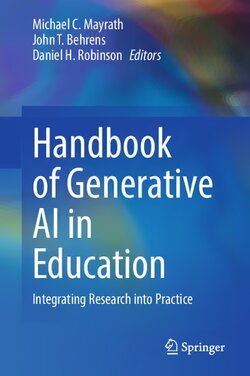 Generative artificial intelligence (AI) has rapidly entered education through free consumer tools, outpacing the ability of schools and universities to respond. Now a new wave of more autonomous agentic AI systems—with the capacity to plan and act towards goals—promises both greater educational personalization and greater disruption. This chapter argues that successfully navigating these innovations requires balancing three core tensions: (1) Implementation Feasibility, or the practical capacity to integrate AI sustainably into real classrooms; (2) Adaptation Speed, or the mismatch between fast-evolving AI capabilities and the slower pace of educational change; and (3) Mission Alignment, or the need to ensure AI applications uphold educational values such as equity, privacy, and pedagogical integrity. First, we review early evidence of generative and agentic AI in various sectors and in frontline education to illustrate these tensions in context. Then, we present a three-tension framework to guide decision-makers in evaluating and designing AI initiatives across K–12 and higher education. We provide examples of how the framework can be applied to plan responsible AI deployments, and we identify emerging trends—such as curriculum-linked AI agents and educator-informed AI design—along with open research directions. We conclude the chapter with recommendations for educational leaders to proactively engage with the opportunities and challenges of AI, so that this technology can be harnessed to enhance teaching and learning in the decade ahead.
 Dieses Kapitel erwähnt ...
 Personen KB IB clear | Keivan Alizadeh , Samy Bengio , B. S. Bloom , Erik Brynjolfsson , Aaron Chatterji , Thomas Cunningham , David J. Deming , Ruiqi Deng , Mehrdad Farajtabar , Zoe Hitzig , Maxwell Horton , Maoli Jiang , Matthew J. Koehler , Danielle Li , Shasha Liu , Yuyan Lu , Iman Mirzadeh , Punya Mishra , Shakked Noy , Christopher Ong , Lindsey R. Raymond , E. M Rogers , Carl Yan Shan , Parshin Shojaee , Kevin Wadman , Xinlu Yu , Whitney Zhang | ||||||||||||||||||||||||||||||||||||||||||||||||||||||||||||||||||||||||
 Begriffe KB IB clear |
Bildungeducation (Bildung)
, Curriculum / Lehrplancurriculum
,  Generative Machine-Learning-Systeme (GMLS)computer-generated text
, GMLS & Bildung
, Generative Machine-Learning-Systeme (GMLS)computer-generated text
, GMLS & Bildung
,  Innovationinnovation
, Innovationinnovation
,  Künstliche Intelligenz (KI / AI)artificial intelligence
, Künstliche Intelligenz (KI / AI)artificial intelligence
,  Lernenlearning
, PersonalisierungPersonalization
, Lernenlearning
, PersonalisierungPersonalization
,  Schuleschool Schuleschool
| ||||||||||||||||||||||||||||||||||||||||||||||||||||||||||||||||||||||||
 Bücher |
| ||||||||||||||||||||||||||||||||||||||||||||||||||||||||||||||||||||||||
Texte |
|
 Dieses Kapitel erwähnt vermutlich nicht ...
Nicht erwähnte Begriffe | Chat-GPT, Digitalisierung, GMLS & Hochschulbildung, GMLS & Schule, Kinder, LehrerIn, Lehrplan 21, Schweiz, Unterricht |
Tagcloud
 Zitationsgraph (Beta-Test mit vis.js)
 Anderswo finden

 Volltext dieses Dokuments
| Addressing the Reality Gap: A Three-Tension Framework for Agentic AI Adoption: Artikel als Volltext @ Springer (:  , 462 kByte; : , 462 kByte; :  ) ) |
 Anderswo suchen
 Beat und dieses Kapitel
Beat hat Dieses Kapitel erst in den letzten 6 Monaten in Biblionetz aufgenommen. Er hat Dieses Kapitel einmalig erfasst und bisher nicht mehr bearbeitet. Beat besitzt kein physisches, aber ein digitales Exemplar. Eine digitale Version ist auf dem Internet verfügbar (s.o.). Es gibt bisher nur wenige Objekte im Biblionetz, die dieses Werk zitieren.
 Biblionetz-History