


Forces of ProductionA Social History of Industrial Automation
|

|
 Diese Seite wurde seit 1 Jahr inhaltlich nicht mehr aktualisiert.
Unter Umständen ist sie nicht mehr aktuell.
Diese Seite wurde seit 1 Jahr inhaltlich nicht mehr aktualisiert.
Unter Umständen ist sie nicht mehr aktuell.
 Zusammenfassungen
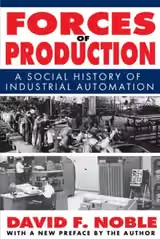 Focusing on the design and implementation of computer-based automatic machine tools, David F. Noble challenges the idea that technology has a life of its own. Technology has been both a convenient scapegoat and a universal solution, serving to disarm critics, divert attention, depoliticize debate, and dismiss discussion of the fundamental antagonisms and inequalities that continue to beset America. This provocative study of the postwar automation of the American metal-working industry—the heart of a modern industrial economy—explains how dominant institutions like the great corporations, the universities, and the military, along with the ideology of modern engineering shape, the development of technology.
Noble shows how the system of "numerical control," perfected at the Massachusetts Institute of Technology (MIT) and put into general industrial use, was chosen over competing systems for reasons other than the technical and economic superiority typically advanced by its promoters. Numerical control took shape at an MIT laboratory rather than in a manufacturing setting, and a market for the new technology was created, not by cost-minded producers, but instead by the U. S. Air Force. Competing methods, equally promising, were rejected because they left control of production in the hands of skilled workers, rather than in those of management or programmers.
Focusing on the design and implementation of computer-based automatic machine tools, David F. Noble challenges the idea that technology has a life of its own. Technology has been both a convenient scapegoat and a universal solution, serving to disarm critics, divert attention, depoliticize debate, and dismiss discussion of the fundamental antagonisms and inequalities that continue to beset America. This provocative study of the postwar automation of the American metal-working industry—the heart of a modern industrial economy—explains how dominant institutions like the great corporations, the universities, and the military, along with the ideology of modern engineering shape, the development of technology.
Noble shows how the system of "numerical control," perfected at the Massachusetts Institute of Technology (MIT) and put into general industrial use, was chosen over competing systems for reasons other than the technical and economic superiority typically advanced by its promoters. Numerical control took shape at an MIT laboratory rather than in a manufacturing setting, and a market for the new technology was created, not by cost-minded producers, but instead by the U. S. Air Force. Competing methods, equally promising, were rejected because they left control of production in the hands of skilled workers, rather than in those of management or programmers.Noble demonstrates that engineering design is influenced by political, economic, managerial, and sociological considerations, while the deployment of equipment—illustrated by a detailed case history of a large General Electric plant in Massachusetts—can become entangled with such matters as labor classification, shop organization, managerial responsibility, and patterns of authority. In its examination of technology as a human, social process, Forces of Production is a path-breaking contribution to the understanding of this phenomenon in American society.
 Dieses Buch erwähnt ...
 Begriffe KB IB clear |
Arbeitwork
,  Computercomputer
, Computercomputer
,  Gesellschaftsociety
, Gesellschaftsociety
,  Managementmanagement
, Managementmanagement
,  Maschinemachine
, Maschinemachine
,  MIT
, Systemsystem MIT
, Systemsystem
|
 Zitationsgraph (Beta-Test mit vis.js)
 Zeitleiste
 15 Erwähnungen
- The Human Use of Human Beings (Norbert Wiener) (1950)

- The End of Work - The Decline of the Global Labor Force and the Dawn of the Post-Market Era (Jeremy Rifkin) (1995)
- The Religion of Technology - The Divinity of Man and the Spirit of Invention (David F. Noble) (1999)
- The Net Delusion - The Dark Side of Internet Freedom (Evgeny Morozov) (2011)
- Recoding Gender - Women's Changing Participation in Computing (Janet Abbate) (2012)
- Critics of Digitalisation - Warners, Sceptics, Scaremongers, Apocalypticists - 20 Portraits (Otto Peters) (2012)

- The Glass Cage - Automation and Us (Nicholas G. Carr) (2014)
- The Zero Marginal Cost Society - The Internet of Things, the Collaborative Commons, and the Eclipse of Capitalism (Jeremy Rifkin) (2014)
- Inventing the Future - Postcapitalism and a World Without Work (Nick Srnicek, Alex Williams) (2015)
- Pressed for Time - The Acceleration of Life in Digital Capitalism (Judy Wajcman) (2015)
- The Democratization of Artificial Intelligence - Net Politics in the Era of Learning Algorithms (Andreas Sudmann) (2019)
- Nachhaltige Digitalisierung - eine noch zu bewältigende Zukunftsaufgabe (Michael von Hauff, Armin Reller) (2020)
- Abstractions and Embodiments (Janet Abbate, Stephanie Dick) (2022)
- Power and Progress - Our Thousand-Year Struggle Over Technology and Prosperity (Daron Acemoglu, Simon Johnson) (2023)
- Making a case for computer literacy - the German Informatics Society and the emerging field of computer education, late 1960s–early 1990s (Carmen Flury, Michael Geiss) (2024)
 Co-zitierte Bücher
Das Kapital
(Karl Marx)
Work, Progress, and Prosperity in a Time of Brilliant Technologies
(Erik Brynjolfsson, Andrew McAfee) (2014)

Technological and Economic Origins of the Information Society
(Robert Beniger) (1986) 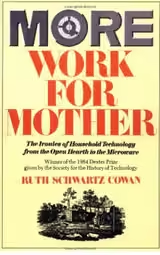
The Ironies Of Household Technology From The Open Hearth To The Microwave
(Ruth Schwartz Cowan) (1983) 
 Volltext dieses Dokuments
| Forces of Production: Gesamtes Buch als Volltext (: 3255 kByte) |
 Anderswo suchen
 Beat und dieses Buch
Beat hat dieses Buch während seiner Zeit am Institut für Medien und Schule (IMS) ins Biblionetz aufgenommen. Er hat dieses Buch einmalig erfasst und bisher nicht mehr bearbeitet. Beat besitzt kein physisches, aber ein digitales Exemplar. (das er aber aus Urheberrechtsgründen nicht einfach weitergeben darf). Aufgrund der wenigen Einträge im Biblionetz scheint er es nicht wirklich gelesen zu haben.
 Biblionetz-History