


Participants’ Perception of Tasks in an Informatics ContestJiří Vaníček, Václav Šimandl
  Zu finden in: Informatics in Schools: Engaging Learners in Computational Thinking (Seite 55 bis 65), 2020
|
 |
 Diese Seite wurde seit 3 Jahren inhaltlich nicht mehr aktualisiert.
Unter Umständen ist sie nicht mehr aktuell.
Diese Seite wurde seit 3 Jahren inhaltlich nicht mehr aktualisiert.
Unter Umständen ist sie nicht mehr aktuell.
 Zusammenfassungen
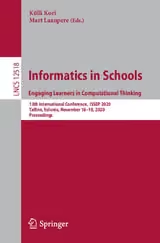 Bebras is a contest organized for schools to promote computational thinking and new tasks are developed for it every year. The contest is held online in over 50 countries around the world and its results provide a great deal of information regarding difficulty levels of particular tasks and factors influencing participants’ success in the contest. Our paper brings an analysis of such hard data in relation to statements of those participants who expressed their opinion on the difficulty of particular tasks and whose statements could be matched with their actual academic performance in the contest. Questionnaires were voluntarily completed by contestants participating in the Senior category (for the oldest participants aged over 16) from the Czech Republic.
Statistical analysis of contest results and perceived task difficulty provided new findings. There is no relationship between the proportion of participants with wrong answers to tasks and participants’ subjective perception of task difficulty. Subjective difficulty is more aptly expressed in terms of the proportion of participants who did not answer the task. The contest was perceived as being easier by those participants who achieved higher scores in it. Male participants demonstrate a higher level of self-esteem in terms of IT skills than female participants. However, female participants’ self-perceptions of their IT skills are slightly more accurate than males’. Results presented in the article could help the authors of the contest to improve compilation of contest tasks and have them included in the Informatics curriculum.
 Dieser wissenschaftliche Zeitschriftenartikel erwähnt ...
 Personen KB IB clear | Valentina Dagiene , Gerald Futschek , Dorothee Graswald , Peter Hubwieser , Elena Hubwieser , Jiří Vaníček , Jeannette M. Wing | |||||||||||||||||||||||||||||||||||||||||||||
 Begriffe KB IB clear | computational thinkingcomputational thinking , Curriculum / Lehrplancurriculum , Informatik-Biber | |||||||||||||||||||||||||||||||||||||||||||||
 Bücher |
| |||||||||||||||||||||||||||||||||||||||||||||
Texte |
|
 Dieser wissenschaftliche Zeitschriftenartikel erwähnt vermutlich nicht ...
Nicht erwähnte Begriffe | Lehrplan 21 |
 Zitationsgraph (Beta-Test mit vis.js)
 2 Erwähnungen
- Informatics in Schools. A Step Beyond Digital Education - 15th International Conference on Informatics in Schools: Situation, Evolution, and Perspectives, ISSEP 2022, Vienna, Austria, September 26–28, 2022 (Andreas Bollin, Gerald Futschek) (2022)
- Bebras Tasks Based on Assembling Programming Code (Jiří Vaníček, Václav Šimandl, Václav Dobiáš)
- Bebras Tasks Based on Assembling Programming Code (Jiří Vaníček, Václav Šimandl, Václav Dobiáš)
- Teaching Coding in K-12 Schools - Research and Application (Therese Keane, Andrew Fluck) (2023)
- Introducing Programming Concepts Through the Bebras Tasks in the Primary Education (Lina Vinikienė, Valentina Dagienė, Gabrielė Stupurienė)
- Introducing Programming Concepts Through the Bebras Tasks in the Primary Education (Lina Vinikienė, Valentina Dagienė, Gabrielė Stupurienė)
 Anderswo finden

 Volltext dieses Dokuments
| Participants’ Perception of Tasks in an Informatics Contest: Artikel als Volltext @ Springer (:  , 698 kByte; : , 698 kByte; :  ) ) |
 Anderswo suchen
 Beat und dieser wissenschaftliche Zeitschriftenartikel
Beat hat Dieser wissenschaftliche Zeitschriftenartikel während seiner Zeit am Institut für Medien und Schule (IMS) ins Biblionetz aufgenommen. Beat besitzt kein physisches, aber ein digitales Exemplar. Eine digitale Version ist auf dem Internet verfügbar (s.o.). Aufgrund der wenigen Einträge im Biblionetz scheint er es nicht wirklich gelesen zu haben. Es gibt bisher auch nur wenige Objekte im Biblionetz, die dieses Werk zitieren.
 Biblionetz-History