


Cyborgs, Centaurs and Self-AutomatorsThe Three Modes of
Human-GenAI Knowledge Work and
Their Implications for Skilling and the Future of Expertise
Steven Randazzo, Hila Lifshitz, Katherine C. Kellogg, Fabrizio Dell'Acqua, Ethan Mollick, François Candelon, Karim R. Lakhani
,
 
|

|
 Zusammenfassungen
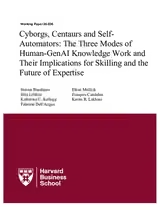 Research on human–AI collaboration in professional settings has focused primarily on isolated
interactions between knowledge professionals and AI, usually at the point of decision making. Yet
generative AI broadens these interactions into an ongoing conversational process that unfolds across the
full workflow. In a field study of 244 global management consultants from the Boston Consulting Group,
we investigated the human–GenAI decision-making workflow and found that knowledge professionals
engaged in three distinct modes of human–AI knowledge co-creation: Fused Knowledge Co-Creation,
Directed Knowledge Co-Creation, and Abdicated Knowledge Co-Creation. These modes correspond to
three types that emerged in practice: “Cyborgs,” “Centaurs,” and “Self-Automators.” Across these modes,
we identify two fundamental questions that structure any collaborative problem-solving dynamic between
human and machine: Who selects what needs to be done? and Who identifies how it gets done? These
questions reveal the underlying architecture of human–AI collaboration, showing not only what GenAI is
used for but also who steers the workflow and how the division of labor unfolds in practice. As a result of
these emergent modes of working with GenAI, Centaurs were upskilling themselves and increasing their
current domain expertise. Cyborgs were newskilling themselves in GenAI-related capabilities, acquiring a
new area of AI expertise. Self-Automators were not increasing either their domain expertise or AI
expertise. We show how what seems to be the same “human-in-the-loop” workflow for decision making
is actually enacted in three ways with significantly different implications for skilling and the future of
work.*
Research on human–AI collaboration in professional settings has focused primarily on isolated
interactions between knowledge professionals and AI, usually at the point of decision making. Yet
generative AI broadens these interactions into an ongoing conversational process that unfolds across the
full workflow. In a field study of 244 global management consultants from the Boston Consulting Group,
we investigated the human–GenAI decision-making workflow and found that knowledge professionals
engaged in three distinct modes of human–AI knowledge co-creation: Fused Knowledge Co-Creation,
Directed Knowledge Co-Creation, and Abdicated Knowledge Co-Creation. These modes correspond to
three types that emerged in practice: “Cyborgs,” “Centaurs,” and “Self-Automators.” Across these modes,
we identify two fundamental questions that structure any collaborative problem-solving dynamic between
human and machine: Who selects what needs to be done? and Who identifies how it gets done? These
questions reveal the underlying architecture of human–AI collaboration, showing not only what GenAI is
used for but also who steers the workflow and how the division of labor unfolds in practice. As a result of
these emergent modes of working with GenAI, Centaurs were upskilling themselves and increasing their
current domain expertise. Cyborgs were newskilling themselves in GenAI-related capabilities, acquiring a
new area of AI expertise. Self-Automators were not increasing either their domain expertise or AI
expertise. We show how what seems to be the same “human-in-the-loop” workflow for decision making
is actually enacted in three ways with significantly different implications for skilling and the future of
work.* Diese Broschüre erwähnt ...
 Personen KB IB clear | Matt Beane , Erik Brynjolfsson , François Candelon , Aaron Chatterji , Thomas Cunningham , Fabrizio Dell'Acqua , David J. Deming , Zoe Hitzig , Edward McFowland III , Katherine C. Kellogg , Lisa Krayer , Karim R. Lakhani , Danielle Li , Hila Lifshitz-Assaf , Ethan Mollick , Shakked Noy , Christopher Ong , Frank Pasquale , Saran Rajendran , Lindsey R. Raymond , Carl Yan Shan , Kevin Wadman , Whitney Zhang | |||||||||||||||||||||||||||||||||||||||||||||
 Fragen KB IB clear | Wie nutzen Menschen GMLS?How do people use GMLS? | |||||||||||||||||||||||||||||||||||||||||||||
 Begriffe KB IB clear |
ExpertiseExpertise
,  Generative Machine-Learning-Systeme (GMLS)computer-generated text
, Jagged Frontier
, Generative Machine-Learning-Systeme (GMLS)computer-generated text
, Jagged Frontier
,  Managementmanagement Managementmanagement
| |||||||||||||||||||||||||||||||||||||||||||||
 Bücher |
| |||||||||||||||||||||||||||||||||||||||||||||
 Texte |
|

 Diese Broschüre erwähnt vermutlich nicht ...
Nicht erwähnte Begriffe | Chat-GPT, Competent, GMLS & Bildung, GMLS & Schule, Proficient |
 Zitationsgraph (Beta-Test mit vis.js)
 1 Erwähnungen
- Vom Deskilling zum Newskilling - Der blinde Fleck emergenter Kompetenzverschiebungen durch generative KI (Doris Weßels, Miriam Maibaum) (2026)
 Volltext dieses Dokuments
| Cyborgs, Centaurs and SelfAutomators: Gesamtes Buch als Volltext (:  , 2653 kByte; : , 2653 kByte; :  ) ) |
 Anderswo suchen
 Beat und diese Broschüre
Beat hat diese Broschüre während seiner Zeit am Institut für Medien und Schule (IMS) ins Biblionetz aufgenommen. Beat besitzt kein physisches, aber ein digitales Exemplar. Eine digitale Version ist auf dem Internet verfügbar (s.o.). Es gibt bisher nur wenige Objekte im Biblionetz, die dieses Werk zitieren.
 Biblionetz-History