


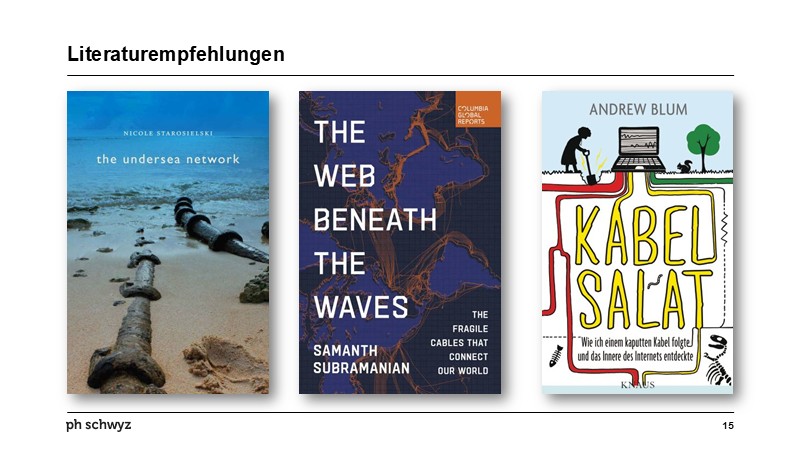
The Undersea Network
Nicole Starosielski
,

|

|
 Dieses Biblionetz-Objekt existiert erst seit Juli 2026.
Es ist deshalb gut möglich, dass viele der eigentlich vorhandenen Vernetzungen zu älteren Biblionetz-Objekten bisher nicht erstellt wurden.
Somit kann es sein, dass diese Seite sehr lückenhaft ist.
Dieses Biblionetz-Objekt existiert erst seit Juli 2026.
Es ist deshalb gut möglich, dass viele der eigentlich vorhandenen Vernetzungen zu älteren Biblionetz-Objekten bisher nicht erstellt wurden.
Somit kann es sein, dass diese Seite sehr lückenhaft ist.
 Zusammenfassungen
 In our "wireless" world it is easy to take the importance of the undersea cable systems for granted, but the stakes of their successful operation are huge, as they are responsible for carrying almost all transoceanic Internet traffic. In The Undersea Network Nicole Starosielski follows these cables from the ocean depths to their landing zones on the sandy beaches of the South Pacific, bringing them to the surface of media scholarship and making visible the materiality of the wired network. In doing so, she charts the cable network's cultural, historical, geographic and environmental dimensions. Starosielski argues that the environments the cables occupy are historical and political realms, where the network and the connections it enables are made possible by the deliberate negotiation and manipulation of technology, culture, politics and geography. Accompanying the book is an interactive digital mapping project, where readers can trace cable routes, view photographs and archival materials, and read stories about the island cable hubs.This book traces how today’s digital circulations are trafficked underground
and undersea, rather than by air. It follows signals as they move at the speed
of light, traveling through winding cables the size of a garden hose. En route,
they get tangled up in coastal politics at landing points, monitored and maintained
at cable stations, interconnected with transportation systems and atmospheric
currents, and embedded in histories of seafloor measurement. Cable
infrastructures remain firmly tethered to the earth, anchored in a grid of material
and cultural coordinates. The Undersea Network descends into these
layers to reveal how such environments—from Cold War nuclear bunkers to
tax-exempt suburban technology parks; from coasts inhabited by centuries-old
fishing communities to the homes of snails, frogs, and endangered mountain
beavers—continue to underlie, structure, and shape today’s fiber-optic links.
From this vantage point, apparently outside the network, one can see the hidden
labor, economics, cultures, and politics that go into sustaining everyday intercontinental
connections. Rather than envisioning undersea cable systems as
a set of vectors that overcome space, The Undersea Network places our networks
undersea: it locates them in this complex set of circulatory practices, charting
their interconnections with a dynamic and fluid external environment.
In our "wireless" world it is easy to take the importance of the undersea cable systems for granted, but the stakes of their successful operation are huge, as they are responsible for carrying almost all transoceanic Internet traffic. In The Undersea Network Nicole Starosielski follows these cables from the ocean depths to their landing zones on the sandy beaches of the South Pacific, bringing them to the surface of media scholarship and making visible the materiality of the wired network. In doing so, she charts the cable network's cultural, historical, geographic and environmental dimensions. Starosielski argues that the environments the cables occupy are historical and political realms, where the network and the connections it enables are made possible by the deliberate negotiation and manipulation of technology, culture, politics and geography. Accompanying the book is an interactive digital mapping project, where readers can trace cable routes, view photographs and archival materials, and read stories about the island cable hubs.This book traces how today’s digital circulations are trafficked underground
and undersea, rather than by air. It follows signals as they move at the speed
of light, traveling through winding cables the size of a garden hose. En route,
they get tangled up in coastal politics at landing points, monitored and maintained
at cable stations, interconnected with transportation systems and atmospheric
currents, and embedded in histories of seafloor measurement. Cable
infrastructures remain firmly tethered to the earth, anchored in a grid of material
and cultural coordinates. The Undersea Network descends into these
layers to reveal how such environments—from Cold War nuclear bunkers to
tax-exempt suburban technology parks; from coasts inhabited by centuries-old
fishing communities to the homes of snails, frogs, and endangered mountain
beavers—continue to underlie, structure, and shape today’s fiber-optic links.
From this vantage point, apparently outside the network, one can see the hidden
labor, economics, cultures, and politics that go into sustaining everyday intercontinental
connections. Rather than envisioning undersea cable systems as
a set of vectors that overcome space, The Undersea Network places our networks
undersea: it locates them in this complex set of circulatory practices, charting
their interconnections with a dynamic and fluid external environment. Bemerkungen zu diesem Buch
The Undersea Network offers a new way to look at digital media systems in
ecological terms. Although research on media ecology—from Neil Postman’s
studies of mass media to Matthew Fuller’s Media Ecologies—understand the
environment as a world of content, The Undersea Network extends the environment
to encompass the social, architectural, and natural ecologies through
which this content is distributed.54 Here, global information flows are not positioned
as equalizing, deterritorializing, and antithetical to fixed or hierarchical
structures, but instead are always routed through dynamic fields made up of
varied directional circulations. The challenge for networked circulations today
is not how to overcome fixed barriers, but how to navigate in a world where everything
is already mobile. The title of this book, The Undersea Network, thus
refers not simply to the cables that are being analyzed, but to the book’s methodological
intervention: to see networks as always embedded within complex
and multidirectional circulatory practices—not a static territory, but a fluid
environment in which our connections must be both insulated and grounded.In this book, I hope to convey how the network looks to the people who
build, operate, and use it. I visited cable installations in thirteen countries, as
well as the offices and homes of numerous cable workers who have contributed
to these systems. As a white American woman, I was unfamiliar with the culture
and language in many of these places, and I relied on people who were
in the industry and resided in these geographies to make the systems legible.
Almost always, it was men—an analyst at a cable company in New Zealand, a
distant relative in Guam, and a software developer in Yap—who broadened my
mobility and helped me gain access to cable networks. While the cable industry
is overwhelmingly male, many women have also been involved in the industry,
particularly in labs and in project management, sales, marketing, route
surveying, and legal affairs. To get to cable sites, I also relied extensively on the
infrastructures of transportation (roads, boats, planes, and trains) with which
the cable systems have been interconnected. My own subject position—as I
traversed heterogeneous infrastructures and environments, often feeling out
of place—heightened my perception of cables’ ongoing requirements for interconnection
as well as their vulnerabilities and need for insulation. Kapitel


 Dieses Buch erwähnt ...
 Personen KB IB clear | Genevieve Bell , Paul Dourish , Paul N. Edwards , Geert Lovink , Siva Vaidhyanathan | |||||||||||||||||||||||||||||||||||||||||||||
 Begriffe KB IB clear |
 Digitalisierung
, Digitalisierung
,  Internetinternet
, Internetinternet
,  Netzwerknetwork
, Netzwerknetwork
,  Politikpolitics
, Unterseekabel Politikpolitics
, Unterseekabel
| |||||||||||||||||||||||||||||||||||||||||||||
 Bücher |
|


Tagcloud
 Vorträge von Beat mit Bezug
- OST oder WEST
Sommer-Retraite der School of Management der Fachhochschule OST
SQUARE, St. Gallen, 27.08.2026
 Zitationsgraph
Zitationsgraph (Beta-Test mit vis.js)
 5 Erwähnungen
- Coding Literacy - How Computer Programming Is Changing Writing (Annette Vee) (2017)

- The Atlas of AI (Kate Crawford) (2021)
- Internet for the People ( Ben Tarnoff) (2022)
- Informationsströme in digitalen Kulturen - Theoriebildung, Geschichte und logistischer Kapitalismus (Mathias Denecke) (2023)

- The Tech Coup - How to Save Democracy from Silicon Valley (Marietje Schaake) (2024)
Co-zitierte Bücher

Computers, Programmers, and the Politics of Technical Expertise
(Nathan L. Ensmenger) 

Technological and Economic Origins of the Information Society
(Robert Beniger) (1986)  Volltext dieses Dokuments
| a network of islands: Kapitel als Volltext (:  , 366 kByte) , 366 kByte) |
| cabled depths: Kapitel als Volltext (: , 412 kByte) |
| circuitous routes: Kapitel als Volltext (: , 503 kByte) |
| gateway: Kapitel als Volltext (: , 571 kByte) |
| pressure point: Kapitel als Volltext (: , 1578 kByte) |
| shor t-circuiting discursive infrastructure: Kapitel als Volltext (: , 380 kByte) |
| Surfacing: Kapitel als Volltext (: , 412 kByte) |
| The Undersea Network: Gesamtes Buch als Volltext (: 6060 kByte) |
| The Undersea Network: Gesamtes Buch als Volltext (: , 5002 kByte) |
 Anderswo suchen
Beat und dieses Buch
Beat hat dieses Buch erst in den letzten 6 Monaten in Biblionetz aufgenommen. Beat besitzt kein physisches, aber ein digitales Exemplar. (das er aber aus Urheberrechtsgründen nicht einfach weitergeben darf). Beat hat dieses Buch auch schon in Vorträgen erwähnt.
 Biblionetz-History